Abstract
The emerged ‘new woman’ in the ‘toxic patriarchal society’ stands against oppression and fights back with resistance, which is well portrayed through relentless and unshakable spirit of evolving women writers such as Meena Kandasamy. This paper highlights the way Kandasamy makes her unnamed narrator use language as a weapon against oppression and violence of deadly masculinity and patriarchy. Further it explores the stratagems applied in an abusive marriage with a misogynist husband who imposes clampdowns and inhumaneness upon the woman of the house that too on a feminist writer who finally backfires with her flaming voice writing the narrative of dictatorship of the patriarch cum psychic husband and freedom of her feminine psyche from the shackles.
Keywords: Patriarchy; narrative; identity; feminine; oppression; identity.
Indian women have been progressive a lot with resilient strides from early Vedic period to postmodern era, passing through Mughal Period to Colonial and post-independence period with influence of feminist movements. In the period when Britishers colonized the country, many writers like Torulata Dutt, Rajlakshmi Debi, Krupabai Sathianandhan, Pandita Ramabai Saraswati, Swarna Kumari Ghosal, and Cornelia Sorabji scripted with an altering perspective and a convincing societal drive.
The next generation of Indian women writers including Nayantara Sehgal, Kiran Desai, Amrita Pritam, Arundhati Roy, Shashi Deshpande, Chitra Banerjee Divakaruni, Anita Desai, Shobha De, Githa Hariharan, Jhumpa Lahiri, Ismat Chughtai, Jotirmoyee Devi, Begum Rokeya Sakhawat Hussain, Bama Faustina, Baby Halder, Rajam Krishnan, Sujata Bhatt, Meena Kandasamy, Manjul Bajaj and Samhita Arni are such female psyche who got recognition for their creativity, straightforwardness and contribution to Indian Feminist Writings with their much-appreciated works. Their female characters portrayed vivid experiences of life as a woman and how the psyche emerged and a ‘new woman’ came into existence gradually. These writers have made their women characters insistently voice to reject the imposed burden of patriarchal supremacy of men hence due to the predominant gender perception, they have always been thought-out frail, incompetent and therefore subdued. Even Indian epics such as Ramayana and Mahabharata are retold and re-interpreted from Sita and Draupadi’s feminist perspective.
A ferocious woman writer Meena Kandasamy voiced various issues of caste, poverty and violence in Southern India in The Gypsy Goddess her debut novel. Her second novel When I Hit You: Or, a Portrait of the Artist as a Young Wife is written in first-person with usage of an unnamed narrator who is a newly-wed writer undergoing hasty societal seclusion, inaccessibility to social platforms and life-threatening violence under her husband’s authoritative behaviour. It’s a fictional work but with autobiographical reflex hence Kandasamy’s own marriage also went worse in the same way. This narrative seems not just of one Indian woman but behind this story, the stories lie of thousands and lakhs of Indian women who suffer in their marriages. The National Family Health Survey last year found that
“over 30 percent of women have been physically, sexually or emotionally abused by their partners at some point. This book is Kandasamy’s rebuke to those who think privilege, financial or educational, protects against harm. Her characters are never named, their anonymity allowing the reader to slip easily into their skins.” (Maher)
Consequently in this terrifying, eye-opening and heartbreaking writing, Kandasamy has put up a ceaseless resistance to agony and travail through her strong lexis. She says “I am the woman who has tried to shield herself from the pain of the first person singular. I am the woman who tum-my-rubs every received taunt so that it can be cajoled into sentences.” (Kandasamy 248) She further expresses that she is the woman
“who stands in the place of the woman who loathes to enter this story in any of its narrations- police or procedural, personal or fictional- because that woman has struggled so hard and so long to wriggle out of it- and now, when asked to speak, she would much rather send a substitute. Sharing stories might be catharsis, but to her it is the second, more sophisticated punishment. I am the woman deputed on her behalf.” (Kandasamy 248)
The narrative moves ahead with a nerve-wracking pace like an extended poem in the form a prose appearing as a feminist anthem, crafted onward like a manifesto realizing oneself. Kandasamy’s narrative can’t be delimited hence it has a pounding heart, with comprehensively acknowledged pursuit for independence and sense on the earth where women are still distressingly belittled. She expresses being the representative of new emerged woman who could be “removed from the brutality of the everyday- from its dying grasshoppers and fading flowers and starving children and drowning refugees” (248) and “sheltered within words, the one distanced into a movie running in her mind, the one asked to bear the beatings, the one who endures everything until something snaps so that fate can escape her.” (248-249)
Kandasamy portrays the image of new woman via the emancipated feelings of her narrator who says, “I am the woman with wings, the woman who can fly and fuck at will.” (247) She has “smuggled this woman out of the oppressive landscape of small-town India.” (247) She adds that she needs to “smuggle her out of her history, out of the do’s and don’ts for good Indian girls” hence she has been limited in the confinement of set patriarchal codes of conduct from centuries. (247-248)
The story starts with lines by the narrator how her mother never stops talking about what had happened past five years, though with each year, the story had “mutated and transformed, most of the particulars forgotten” (3) such as events’ sequence, day, date, month and time of the year etc. but she keeps on giving absurd details about the physical and mental condition she was in when her daughter escaped from the brutal situation at her husband’s place she was stuck into, by saying, “were they even feet? Were they the feet of my daughter? No! Her heels were cracked and her soles were twenty-five shades darker than the rest of her, and with one look at the state of her slippers you could tell that she did nothing but housework all the time. They were the feet of a slave.” (4) She further continues that when their daughter came back to them after a bad marriage with a criminal husband, she came “with her feet looking like a prisoner’s, all blackened and cracked and scarred and dirt an inch thick around every toenail” (4) and her father washed her feet with his own hands, scrubbing and scrubbing and scrubbing them with hot water and salt and soap and an old toothbrush and applying cream and baby oil to clean and soften them”. (4-5) The condition of the protagonist is also described with such phrases that she was “brittle and empty like a shell” (6) and it took months to get her back to normal moreover, “her hair was swarming” with lice that drained all the energy of the girl. (7)
The protagonist being the writer finally decides to write her own story after listening various plagiarized versions with added anecdotes created by her mother to tell people. Kandasamy calls “authorship” is a “trait” which one needs to take very seriously being “ruthless”. (9)
The journey of the narrator towards being an assertive and strong voice is not so easy. It initiates with a depriving of the narrator’s independence after her marriage to a University lecturer, Marxist and one-time revolutionary person in South India. Her husband is a communist with his beliefs covering his own sadism and tries to control her. The narrator expresses that she feels “blank” like “a house after a robbery” and like “a mannequin stripped of its little black dress and dragged away from the store window, covered in a bedsheet and locked off in the godown”. (16) She talks about his sadist attitude and “the plainness that makes him pleased”. (16) She further releases her feelings, “This plainness that has peeled away all my essence, a that can be controlled and moulded to his will” though she took that “plainness” she wears as a protection “mask” further not only to hide her face but to “prevent arguments” with him. (16) Her husband wanted to play the role of a perfect wife, therefore, to escape punishments, she says
“I begin to wearing my hair the way he wants it: gathered and tamed into a ponytail, oiled, sleek, with no sign of disobedience. I skip the kohl around my eyes because he believes that it is worn only by screen-sirens and seductresses. I wear a dull T-shirt and pajama-bottoms because he approves of dowdiness.” (15)
Further she proceeds saying that it gave her a feel of being a woman who has given up in the life “to play the part of the good housewife. Nothing loud, nothing eye-catching, nothing beautiful.” (16) Her husband wanted her to look like “a woman whom no one want to look at or more accurately no one even sees.” (16) Her life became depedent on him while playing a role of a dutiful wife who had to pretend that her husband is the hero of everyday. She compares and expresses her freedom what she relished before marriage saying that “a once-nomad” is “to be confined” now to “the four walls of a house”. (20) Though she is confined to home. She tries to seek solace in reading and writing, but “the house appears to shrink the minute her husband is home, how there is nowhere to run, nowhere to hide, nowhere to evade his presence.” (21)
Through her firm and fierce usage of language, she exposes the double standards and dialectics of patriarchal and in specific of Communism putting forth “she must learn that a Communist woman is treated equally and respectfully by comrades in public but can be slapped and called a whore behind closed doors.” (34)
After moving to another city where she couldn’t now anything and that became torturous for her “an assault on her tongue, mind and body”. The linguistic barrier restricted her speech to fulfill duties as a wife like bringing vegetables or any grocery item. Moreover at that stay, her husband with a “self-inflicted ordeal” (50) blackmails and forces her to deactivate her Facebook account, which was her “lifeline to the world outside” (52) in Mangalore with all her professional links as a freelance writer to promote her work, give her news, and to keep her in the loop of the literary scene. Very consciously knowing that it is her space as a writer he wanted her to cut herself off from Facebook though she calls it as “an act of career suicide” (52). The control freak further makes her submit all her email accounts to him to operate on her behalf in addition keeps an eye on her phone too. He does like her writing articles in English calling it being a poet prostitute or whore moreover absurdly connects it to colonization period where whore used to be a link between the colonizer and the colonized. More he hates the feminism inside her treating it as a problem between to remain good couple. The narrator gradually cloistered to her silence to make sense of the world. For her “To stay silent is to censor all conversation. To stay silent is to erase individuality. To stay silent is an act of self-flagellation…” (161
Her silence strategy irritated the man further. Therefore she was frequently raped and beaten down even with routine household stuff such as the hose of the washing machine and the power cord for her laptop. She was kicked in her stomach, her hair gathered in bunch, blood rushing to her head, moreover dragged “from the table and into the bedroom”. (163) Even her parents kept on saying to tolerate this all brutality and beastly violence to save her marriage and didn’t understand what she really went through. About the narration of being beaten down, Preti Taneja in the review of the novel When I Hit You expresses,
“through Kandasamy’s use of stylistic devices such as repetition, are we – the narrator reflects that every moment has narrative potential. The risk of desensitization is averted: the novel becomes a meditation on the art of writing about desire, abuse and trauma.” (Taneja)
Kandasamy expresses with audacity the gut-wrenching experience how the protagonist feels to be raped within a marriage. She feels like dead person whose ceremonial feeding goes on. She describes it metaphorically “motionless, devoid of touch, taste sight smell sound, the corpse feels nothing. It lies there, playing the role of the obedient half of an obligatory ritual, as close relatives drop white rice through its parted lips. It is a feeling of unfeeling.” (168) She feels humiliated and calls that her body learns “to play dead” and “extends it own threshold of pain and shame and brutality”. (169)
Kandasamy talks about petite bourgeois mindset of those people in the society for whom shame is “not the beatings, not the rape. The shaming is in being asked to stand to judgment.” (219) She applies her own strategies to get rid of this marriage by not conceiving a child and further not reverting back to any of his torture by speaking to him. Silence becomes another weapon after her writings hence she understood that “there are no screams that are loud enough to make a husband stop”. (167)
Using language as a weapon, she includes epigraphs at the start of chapters from Pilar Quintana, Wislawa Szymborska, Anne Sexton, Kamala Das, Margaret Atwood, and Malathi Maithri and many more correlating herself to these feminist writers “beyond caste, race or culture, even beyond language difference”. (Taneja) Added to her style, Sudipta Dutta says about the title selection in her review that
“The title, unwillingly or not, reminds us of an illustrious predecessor, James Joyce, and his first novel, A Portrait of the Artist as a Young Man, in which Stephen Dedalus or the writer’s literary alter ego, finds words to create his identity and his art, to describe Dublin and her many moods, to defy convention on nationality, language, religion”. (Dutta)
Kandasamy dissects the “Indian form of toxic masculinity” by giving illustrations of Indian male leaders never wanted to be seen at public platforms with a woman by their side hence it meant for them that they were not masculine enough, not the man enough to lead the people, if they go for conjugal relationships therefore they continued “to remain bachelor politicians”. (124)
When I HIt You is a powerful gender narrative and an expression of protest against suppression and inhumane conditions of existence a woman was fallen into, how she survived and came out the traumatic situation. Therefore such gender narratives including gender issues and women emancipation become the new catchphrase across the globe with very fast pace transforming social structures and prevailed inequalities settling the minds of people.
Kandasamy’s feminist narrative is a scorching chronicle of one woman’s encounter with marital rape and abuse, how she castoffs the overtly idolized image of the good Indian girl opening up in a very affirm voice which exhibits desire, feels pain and has unyielding courage. It screams from its modest case, denying to be silenced in its search for love and identity; leaving the gut-wrenching impression how the epitome of submissive Indian femininity is in ruins at last and a new woman has emerged out of the cocoon.
Works Cited
- Dutta, Sudipta. Words gave her wings. May 27, 2017. Retrieved on July 25, 2021.
- https://www.thehindu.com/books/books-reviews/words-gave-her-wings/article18583321.ece
- Kandasamy, Meena. When I Hit You. Juggernaut Books, New Delhi, 2018.
- Kishore, Henry. The Evolution of Indian Women Psyche: A Chronological Study of Women and Woman Writers in India. 2017.
- Maher, Sanam. She Was Abused by Her Husband. So Is the Narrator of Her New Book. The New York Times, March 17, 2020.
- Taneja, Preti. When I Hit You: Or, A Portrait of the Writer as a Young Wife by Meena Kandasamy – review. July 7, 2017. Retrieved on July 25, 2021.
- https://www.theguardian.com/books/2017/jul/07/when-i-hit-you-meena-kandasamy-review


 Naheed Akhtar is an accomplished Assistant Professor of English, Writer and Poet based in Hyderabad, Southern India. She has published three poetry collections, namely ‘Phantasms of My Heart’, ‘The Earth’s Love’ and ‘The Morphine’. Naheed’s literary works have received several prestigious awards, including the Gujarat Sahitya Academy Award, which she was honoured with for three consecutive years from 2020 to 2022. Naheed has been actively participating in various literary festivals and her third book, ‘The Morphine’, was launched at the National Kolkata Book Fair on the invitation of the Sahitya Academy and the Department of Culture and Language in association with the government of West Bengal. Her poems have also been published in various National and International Magazines. Apart from writing in English, Naheed also writes in Urdu and has participated in Mushairas from different parts of India, receiving Certificates of Participation. She can be contacted at naheedakhtar123119@gmail.com.
 Dr. Molly Joseph is a Professor, Poet (Bilingual) from Kerala, who writes Travelogues, Short stories and Story books for children. She has published seventeen books -14 Books of Poems, two Novels (translation) and a Storybook for Children. She has won several accolades which include, the Wordsmith Award 2019, the India Women Achiever’s Award 2020 and the Best English Poetry Book of the Year Awards 2020, 2022 (ALS, New Delhi). She believes in the power of the word and writes boldly on matters that deal with the contemporary. With her Doctorate in Postwar American Poetry, she has won Galaxy Award in Experimental Poetry, developing an indigenous diction characterized as ‘Ribbon Poetry’. She can be reached at mynamolly@gmail.com
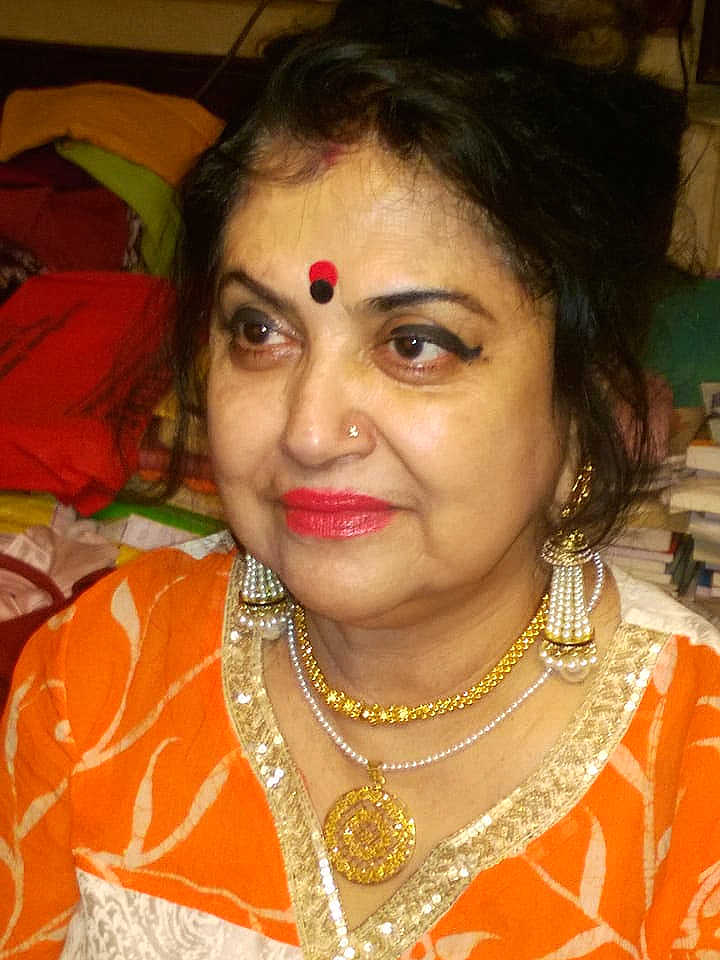 Prof. Dr Laksmisree Banerjee is an Award-Winning Globally well-known Poet, Litterateur, Editor, Writer, Vocalist, Ex Vice Chancellor and University Professor of English and Cultural Studies. She is a Sr. Fulbright, Commonwealth and National Scholar of the University of Calcutta. Widely published and anthologised, she has Nine Books of Poetry to her credit and One Hundred Research / Academic Publications including Books. She is the Recipient of the International Reuel Lifetime Achievement Award, Literoma Laureate Lifetime Achievement Award for Art and Literature, the UGC Grants Postdoctoral Research Award for her groundbreaking Work on World Women Poetry, the Kala Ratnam Award, Two Women Achievers Awards, Honour of Connoisseur of the Literary Arts (Tunisian Asian Society) and many more. She is a Sr. Rotarian, Multiple Paul Harris Fellow, and the Indian President’s Nominee on Boards of Central Universities. Dr Banerjee believes in using her Pen and Voice for Social Justice, Transformation and International Goodwill.
 Montzerrat Licona is a Mexican Neuropsychologist, Researcher, and Writer, born in Jalisco, Mexico. She holds a master’s degree in Cognitive Behavioral Neuropsychology of Neurodevelopment. Montzerrat is the author of the Best Seller “Being, love and conscious sexuality; 7 arts of your mind” and “The voice of the wind in silence,” in addition to contributing to various anthologies and literary magazines. She is the Director and founder of the Conscious Neuropsychological Center in Human Development and an active member of the Royal International Academy and the National and International Institute of the Society of Arts. Montzerrat also serves as the Head of Communications and Coordinator in Mexico of the Writers Capital Foundation.


 Sushant Thapa (1993) is from Biratnagar, Nepal. He is an M.A. in English literature from Jawaharlal Nehru University, New Delhi, India. His fourth and upcoming book of poems titled “Love’s Cradle” is going to be published by World Inkers Printing and Publishing, New York, USA. He teaches Business English to undergraduate students in Biratnagar, Nepal.