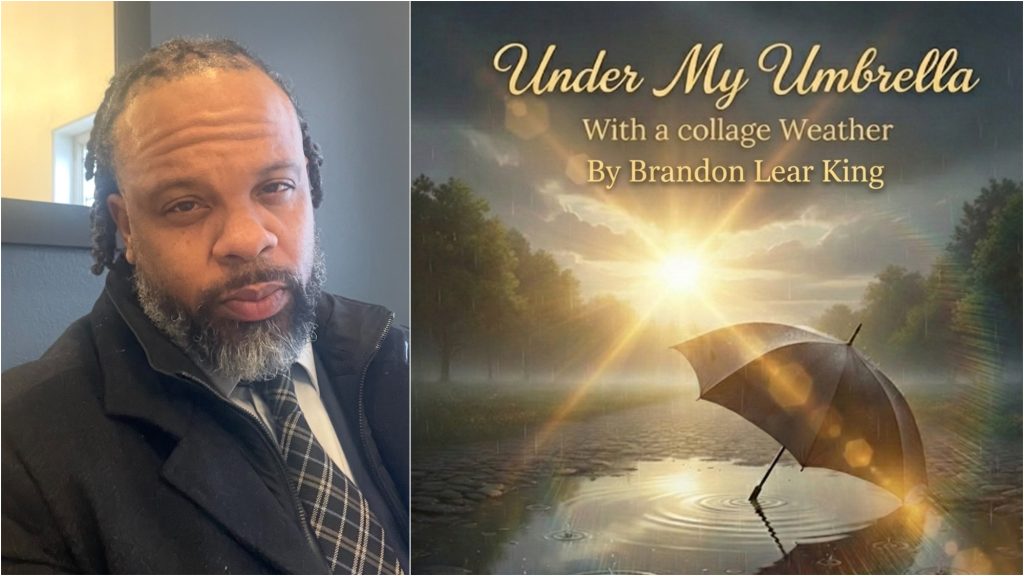
Brandon King’s Under My Umbrella: With a Collage of Weather, a self-published collection of 166 pages released in 2012, presents a sustained sequence of lyric poems that examine personal resilience, romantic attachment, spiritual conviction, and the ordinary pressures of adult life. Organized into six thematic divisions—Inspiration, Love, Mind, Body and Soul, Romance, To Whom, and A Glimpse Beyond the Horizon—the volume adopts the umbrella as a central metaphor for shelter amid uncontrollable external and internal storms. The introduction explicitly frames the work as both shield and mirror, inviting readers to confront their own trials while finding reassurance in shared human experience. King writes from a first-person perspective that remains consistently intimate, producing a collection that functions less as experimental verse and more as a deliberate record of emotional and moral navigation.
The structural design reinforces thematic coherence. The opening Inspiration section establishes the poet’s foundational concerns: fatherhood as lifelong vocation, mental discipline, and the necessity of faith when confronted by loss or disruption. Poems such as “Weather,” “Fatherhood: (A Lifelong Vocation),” and “My Inspiration: (Digging for Light)” deploy meteorological and seismic imagery to convey inner turmoil and subsequent recovery. These pieces transition naturally into the Love and Romance sections, where the speaker shifts from solitary endurance to relational interdependence. Titles like “Love You Love: (The Overwhelming Presence),” “Addiction: (The Thirst for Love),” and “Reminiscing: (Everything About You)” trace the spectrum of attachment—from euphoric fusion to anxious vulnerability—while maintaining the weather motif as a figure for emotional climate. The Mind, Body and Soul division introduces explicit Christian references, evident in “A Prayer Warrior,” “To Talk to Jesus: (The Constant Connection),” and “Against All Odds: (The Sign and the Path),” which ground personal agency in scriptural meditation. The To Whom section broadens the lens to social observation and self-critique, culminating in poems such as “October 31st: (Dusk to Dawn)” and the closing statement on page 149, where the speaker affirms that life “is not all about me.” This progression from individual crisis to communal and transcendent perspective lends the collection an arc that feels purposeful rather than incidental.
Stylistically, King favors free verse with occasional internal rhyme and rhythmic repetition, producing lines that prioritize direct emotional statement over dense allusion or syntactic complexity. Imagery draws heavily from accessible domains—rain, music, roads, anchors, rivers—avoiding esoteric reference in favor of immediate recognition. In “The Love River,” for example, the beloved’s affection is rendered as a “timeless current” that both nourishes and carries the speaker forward; the metaphor is neither novel nor obscure, yet it sustains clarity and affective weight. Parenthetical subtitles, such as “(The Thirst for Love)” or “(The Relentless Choice),” serve as interpretive glosses, guiding the reader toward the poem’s central concern and suggesting an affinity with spoken-word or performance-oriented verse. This transparency enhances accessibility but occasionally reduces linguistic tension; some lines lean toward declarative summary rather than evocative compression. Nevertheless, the consistency of voice—earnest, reflective, and unapologetically masculine in its emphasis on provision and steadfastness—creates cumulative authority across the volume.
Thematic unity constitutes the collection’s principal achievement. King returns repeatedly to the interplay of agency and surrender: the speaker must “stay on the ride” (“Run, Walk, Crawl”), exercise “the relentless choice” (“Catch-22”), and accept that certain burdens, including fatherhood and romantic commitment, admit no retirement (“Fatherhood,” “To me: (My Everlasting Anchor)”). Faith functions not as abstract piety but as practical orientation, supplying the “compass needle” (“The Map of You Maybe”) that steadies the self amid shifting external conditions. Love, meanwhile, appears both as overwhelming presence and as disciplined practice; poems in the Romance section, such as “Fruits: (Her Sweet Harvest)” and “Seduction: (The Inner Freak),” balance sensual celebration with moral accountability. This integration of eros and ethics distinguishes the work from purely confessional modes that risk solipsism. The final section, A Glimpse Beyond the Horizon, extends these reflections into broader existential territory, suggesting that the umbrella’s shelter ultimately points toward transcendence rather than mere survival.
Strengths emerge most clearly in the collection’s sincerity and thematic cohesion. King avoids irony and postmodern detachment, offering instead a poetry of testimony. The recurring motifs of weather, construction, and musical collaboration generate a recognizable symbolic lexicon that binds disparate poems without enforcing rigid allegory. Readers seeking verse that addresses adult responsibilities—parenting, partnership, spiritual maintenance—will find the work resonant precisely because it refuses abstraction. The language remains conversational yet elevated enough to sustain repeated reading; several pieces, notably “Stay Strong: (The Truth Beneath the Surface)” and “Toast to You: (Heaven’s Grace),” achieve a quiet dignity that rewards attention.
Limitations arise chiefly from the self-published context. Occasional clichés (“mind is a terrible thing to waste,” “time heals all wounds”) and repetitive phrasing suggest limited editorial intervention. Some poems resolve their tensions too neatly, substituting affirmation for unresolved complexity. The collection’s length, while demonstrating sustained commitment, produces moments of redundancy; certain relational dynamics reappear with only marginal variation. These shortcomings, however, do not undermine the book’s core purpose. King writes not to innovate poetic form but to document lived conviction, and within those parameters the volume succeeds.
In the broader landscape of early twenty-first-century American poetry, Under My Umbrella occupies a space occupied by other practitioner-writers who prioritize clarity and ethical reflection over avant-garde experiment. Its confessional tone and faith-inflected worldview align it with traditions extending from certain strands of contemporary Christian verse and spoken-word performance, yet it remains distinct in its insistent linkage of personal weather to communal shelter. For scholars of autobiographical poetry or readers interested in the literature of resilience, the collection offers a valuable case study in how metaphor and narrative sequence can transform private trial into shared instruction.
Ultimately, Brandon King’s Under My Umbrella delivers a coherent and emotionally grounded body of work. It records one man’s negotiation of love, duty, and belief without pretense of universality or formal radicalism. The umbrella holds; the collage of weather, however chaotic, is rendered legible. In an era that often privileges fragmentation, the collection’s willingness to affirm continuity and moral effort merits recognition. Readers prepared to engage with its directness will encounter a poetry that consoles as readily as it challenges, fulfilling the promise articulated in the introduction: to provide both protection and honest reflection beneath a common sky.