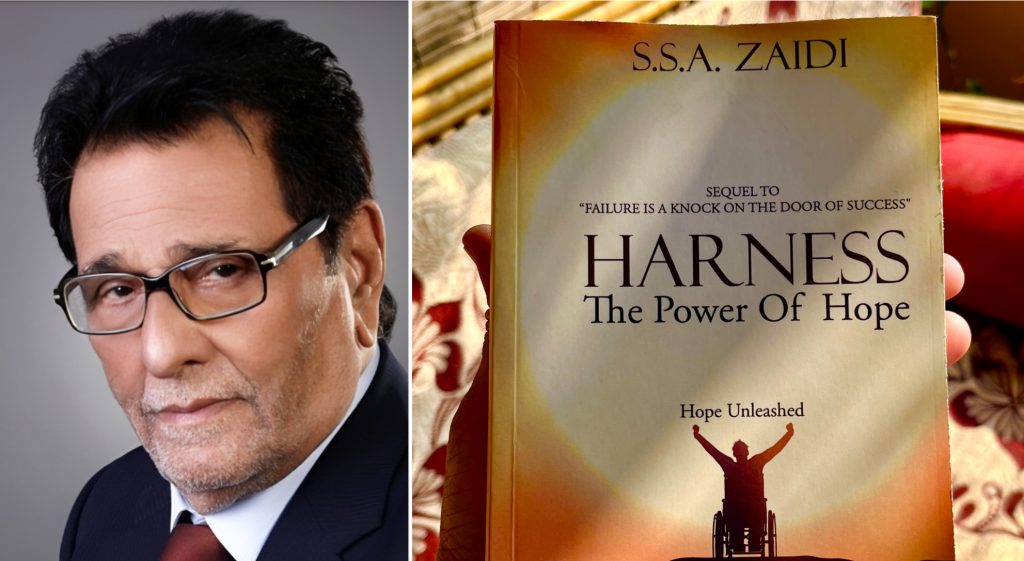
S.S.A. Zaidi, a retired banker, award-winning author, and motivational speaker from a modest village background in eastern Uttar Pradesh, India, has produced a compelling sequel to his earlier work Failure is a Knock on the Door of Success. Published in 2025 by BookLeaf Publishing, Harness the Power of Hope: Hope Unleashed offers a thoughtful exploration of hope as an essential force for navigating life’s inevitable setbacks, stress, anxiety, and despair. Drawing from personal experiences, historical and mythological references, spiritual wisdom, and contemporary psychological insights, Zaidi presents hope not as mere optimism but as a deliberate, actionable mindset that transforms adversity into growth. The book addresses pressing concerns, particularly among younger generations facing intense competition, fear of failure, and mental health challenges, while remaining accessible to a broad readership.
The volume opens with front matter that establishes its tone and purpose. Expressions of gratitude, forewords from mental health professionals and educators, and an overview by Padma Shri Prof. Syed Ainul Hasan underscore the book’s collaborative spirit and scholarly grounding. Zaidi dedicates the work to his late mother and daughter, as well as to cancer patients, with royalties directed toward their treatment through the Sujata and Sesh Foundation. This personal dimension infuses the text with authenticity. The author explicitly notes his use of repetition as a pedagogical tool, revisiting core ideas from multiple angles to reinforce learning and retention. Each of the 27 chapters concludes with “Points to Ponder and Act On,” practical exercises that invite readers to apply concepts immediately.
Structurally, the book progresses logically from personal foundations to broader philosophical and practical applications. Early chapters establish the author’s credentials and core inspiration. Chapter 3, “My Father, My Hero: An Apostle of Hope and Determination,” recounts Zaidi’s upbringing and the disciplined yet hopeful guidance from his parents. Chapter 9, titled with his mother’s Urdu phrase “Beta Kabhin Maayoos Na Hona” (My Son, Never Lose Hope), weaves maternal wisdom with poetic couplets and reflections on betrayal, loyalty, and resilience. These sections ground the narrative in lived reality, showing how familial hope sustained Zaidi through professional hurdles, including unexpected retirement setbacks.
Subsequent chapters expand the theme. Chapter 10, “Hope Explained,” defines hope as a conscious choice that fosters resilience rather than merely alleviating fear. Zaidi draws on Viktor Frankl’s Man’s Search for Meaning (Chapter 6) to illustrate how purpose and hope enabled survival amid Holocaust horrors. Chapter 15, within the broader introduction, and Chapter 14, “Treat Fear as an Instrument of Personal Growth,” advocate cultivating a growth mindset. Readers encounter Rudyard Kipling’s poem “If—” and stories of real-life figures such as Lilius Lionel, Satendra Singh Lohiya, and Nick Vujicic, who triumphed despite severe physical limitations. Chapter 16, “Stories of Hope, Faith, and Triumph,” compiles further inspiring accounts, while Chapter 17 examines the interplay of despair and hope.
Mid-book sections address practical applications. Chapter 18, “Hope as a Stress Buster,” links hope to reduced anxiety, stronger immunity, and emotional regulation, supported by research references and tips for daily practice. Chapter 19, “Hope is the Magic Elixir of Life,” focuses on serious illness, particularly cancer, emphasising hope’s role in sustaining quality of life and medical compliance. Chapter 20, “Be Like a Tree – Be Grounded,” uses arboreal metaphors to teach rootedness, patience, flexibility, and renewal; readers learn to release “dead leaves” (negative attachments) and draw sustenance from deep roots. Chapter 21, “It Shall Be Done – Pinnacle of Hope,” recounts the motivational tale from Peter B. Kyne’s The Go-Getter and Theodore Roosevelt’s self-imposed physical regimen, reinforcing absolute commitment. Chapter 22, “No Mud, No Lotus,” draws on Thich Nhat Hanh to affirm that suffering fertilises growth, much like the lotus emerging pristine from mud. Later chapters connect hope to spiritualism (Chapter 25) and entrepreneurship (Chapter 26), culminating in an epilogue that synthesises the message.
Throughout, Zaidi enriches the discussion with diverse sources: Quranic verses, the Bhagavad Gita, Biblical references, quotes from Barack Obama, A.P.J. Abdul Kalam, Rumi, Emily Dickinson, and Aristotle, plus modern voices such as Joel Osteen and Oneg Shapira. Mythological allusions, including Pandora’s Box, underscore hope’s enduring presence amid adversity. The text repeatedly cautions that it addresses general stress and anxiety, not clinical depression, and urges professional help when needed—a responsible stance that enhances credibility.
The content’s principal strength lies in its integration of personal narrative, scholarly references, and actionable guidance. Zaidi’s village-to-boardroom journey lends credibility, while the repetition of key phrases such as “Never lose hope” and “It shall be done” creates rhythmic reinforcement without redundancy. Each chapter’s reflective prompts transform passive reading into active self-development. The book speaks directly to contemporary issues: FOMO, VUCA environments, post-pandemic mental health strains, and youth suicide linked to academic pressure. By framing failure as feedback and stress as a potential energiser, Zaidi offers a balanced, culturally rooted antidote to despair.
Minor observations include occasional overlap between chapters, yet this aligns with the author’s stated intent to embed concepts deeply. The prose remains clear and conversational, avoiding jargon while maintaining dignity. Overall quality of the book (printing and designing) i could never believe such a precious book could be printed and published this way. The clean layout, elegant typography, and thoughtful placement of inspirational quotes and call-out boxes enhance readability and aesthetic appeal, reflecting care worthy of the message.
In conclusion, Harness the Power of Hope: Hope Unleashed succeeds as both inspirational literature and practical manual. Zaidi demonstrates that hope is not passive wishing but an active, resilient force sustained by determination, gratitude, and community. Readers emerge equipped with tools to reframe setbacks, nurture inner strength, and pursue purposeful lives. Educators, counsellors, young professionals, and anyone navigating uncertainty will find value here. The book stands as a worthy successor to its predecessor and a timely contribution to self-help literature. Highly recommended for its depth, accessibility, and enduring relevance.
Buy Harness the Power of Hope by S.S.A. Zaidi here: https://amzn.in/d/05GVOhHS