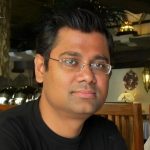
Some journeys unfold across clear, defined paths. Others move through multiple worlds, gathering depth through experience rather than direction. Sankha Sen belongs to the latter. His life does not remain confined within a single discipline. It moves between engineering, music, and literature, carrying continuity through inquiry and expression.
Born in Kolkata, a city shaped by intellectual and artistic traditions, Sankha Sen grew within an environment where culture did not remain separate from daily life. Music and literature existed not as pursuits, but as extensions of awareness. This early grounding continued to inform his journey even as his academic path took him toward Electrical Engineering and later to Germany for higher studies and professional engagement.
His professional life developed within structured systems, shaped by precision, logic, and discipline. At the same time, a parallel space remained active. Music sustained that space. As a guitarist, influenced by the legacy of his father, the renowned musician Swapan Sen, he engaged with performance across stages, studios, radio, and television. His work does not remain bound to a single tradition. It draws from Indian classical forms, extends into Western compositions, and continues to evolve through lived experience across cultures.
This movement across geographies did not fragment his identity. It expanded it. Exposure to different cultural environments refined his artistic perception. He observes that human responses remain fundamentally similar, while cultural forms shape how they are expressed. This understanding informs both his music and his writing.
In recent years, his literary voice has taken a more defined form. Writing in English, Bengali, and German, Sankha Sen approaches language as a medium through which experience is examined rather than described. His works, including Sonkhomonjori and Collection of Feelings, engage with themes of existence, nature, and identity. These are not treated as abstract ideas. They emerge through observation and reflection, often positioned from a distance that allows clarity.
His writing process reflects this orientation. It does not begin with an intention to produce. It begins with a question. An attempt to understand one’s place within a larger order. This questioning becomes the basis for both poetry and narrative. He has indicated that the act of creation, for him, lies in preserving certain thoughts and experiences that may hold relevance beyond the immediate moment.
Balancing multiple roles remains an ongoing discipline. Professional commitments require structure. Creative work requires openness. He navigates this through time management and consistency rather than separation. Early hours, reflective space, and the ability to shift between modes of thinking allow these dimensions to coexist.
Recognition has followed his work, including awards for his contributions to culture and literature. Yet, his reflections indicate that achievement does not conclude the process. It extends it. Each phase becomes part of a larger continuum rather than a final point.
Sankha Sen’s journey holds relevance within a context where individuals often feel compelled to choose a single identity. His life demonstrates that multiple pursuits can remain coherent when they are grounded in a shared inquiry. The relationship between science and art, between profession and expression, does not require resolution. It requires integration.
His recent conversation in Meet the Luminaries, hosted by Prof. Irene Doura Kavadia, presents this journey with clarity and restraint. The discussion moves through his early influences, his transition across countries, and the development of his creative voice. It offers a view into how experience shapes expression without imposing a singular narrative.
Watch the full interview here:
Presented by:
Writers Capital International Foundation
Meet the Luminaries – In conversation with the greatest minds of our times.