The Athens Institute, established in 1995 as an independent, world-wide body of academics and researchers, organizes small academic meetings while also promoting research and producing publications. Over 1000 such academic events have been organized since 1995 attended by scholars from all over the world. Besides the publication of over 200 books, a series of conference papers have also been published as well as the introduction of a series of e-journals.
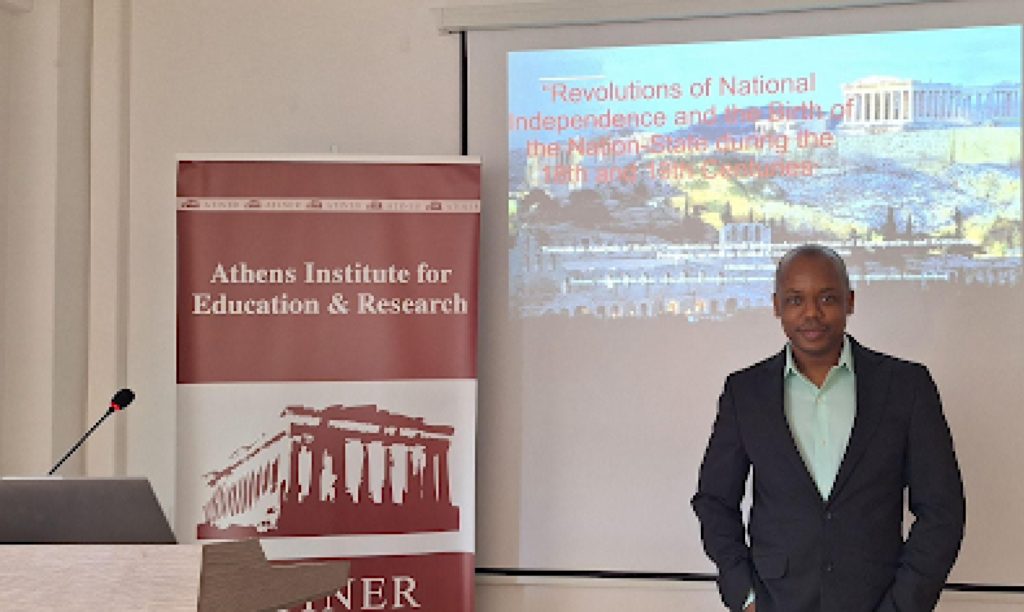
For Greece’s national anniversary marking the War of Independence of 1821 against over 400 years of Ottoman rule, the Athens Institute held its 3rd Special Event under the auspices of the Athenian Academic Periodical, titled “Revolutions of National Independence and the Birth of the Nation-State during the 18th and 19th Centuries” on Monday, March 30, 2026. The topic chosen is very appropriate as it refers to the struggle for independence that reshaped the ideas of sovereignty, citizenship and identity not only on a local scale but on a global one as well through the political, social and cultural dimension that it expressed. This transition from empires to sovereign states was filled with wars and conflicts, ideologies and international interventions as well as the influence of transatlantic revolutionary ideas. It was a time when the ‘Old World’ was coming to an end and the ‘New World’ beginning.
The date of March 25th for celebrating the Greek War of Independence is deeply symbolic as it combines both religious meaning and national identity. It was not chosen to mark the exact beginning of the war for independence as uprisings had started much earlier in various parts of the Peloponnese, but because it symbolically blends faith and freedom. March 25th is the day of the Annunciation in the Orthodox Christian calendar, the moment when the Archangel Gabriel announces to the Virgin Mary she will give birth to Jesus Christ. This symbolizes good news and hope as well as a new beginning for humanity. By linking the war of independence to this day, the uprising was portrayed as a spiritual rebirth of Greece, unifying scattered uprisings and strengthening the connection between Greek identity and Orthodox Christianity. It turns the revolution into not just a political revolt, but a moral and spiritual mission.
The lecture by Obrillant Damus (Full Professor, State University of Haiti, Haiti, Visiting Professor, Laval University & adjunct professor, University of Sherbrooke, Quebec) threw light on another aspect of the Greek War of Independence as it referred to the benefits gained from Haiti’s ‘regenerative and restorative pedagogy’, which refers to ‘a set of methods and knowledge aimed at regenerating ourselves, regenerating others, and repairing the past and the present with a view to human, ecological and planetary sustainability.’ (Damus, 2024). This knowledge is important as it helps the oppressed to overcome the traumas that they experienced under suppressive regimes such as that of the Ottoman Empire. These traumas and experiences are passed on from one generation to the next and therefore it is important for both sides, the oppressed and the oppressor, to understand this and to come to terms with it. This is the difficult part.
Greece benefited from Haiti’s regenerative and restorative pedagogy because Haiti not only sent a shipment of coffee that could be sold for the buying of arms, but also moral support by sending 100 volunteers to fight alongside the Greeks in their fight for freedom, who unfortunately lost their lives on the way to Greece. This supportive act bolstered the self-confidence, the self-esteem, and the determination of the Hellenes to put an end to centuries of Ottoman ‘cultural genocide or ethnocide, physical genocide, the destruction of the Byzantine heritage, and the destruction of religious architectural heritage.’ (Excerpt from Obrillant Damus’s lecture titled “Towards an Analysis of Haiti’s Contribution to Greek Independence in Terms of Regenerative and Restorative Pedagogy, as well as Global Citizenship Education”, Athens Institute on March 30, 2026)
Learn more: Damus, Obrillant (2024). Regenerative and restorative pedagogy: the foundation of new contract for cognitive justice, UNESCO-Prospects.
Sam Zylberberg, 2019 : https://jeretiens.net/le-genocide-grec-pontique-1914-1923/.
Haiti, being the first “Black” republic, set an example for others to follow as its independence in 1804 after a 12-year fight against France marked a turning point for those under colonial rule and slavery. The success of their fight led to the support of other national struggles such as the Greek War of Independence in 1821, ” universalizing human rights and citizenship” (Excerpt from Professor Obrillant Damus’s lecture at the Athens Institute on March 30, 2026)
Although Greece was still fighting for its freedom against Ottoman rule, the 1st National Assembly convened at the township of Epidaurus, where a Decree was signed in January 1822 abolishing slavery. This made Greece the first country in modern Europe to abolish slavery on its soil and globally the second only to Haiti. Such examples of moral and material support set a standard for others to follow.
Haiti responded to the call for help sent on August 20, 1821, by the Greek intellectual Adamantios Korais, a member of the Philhellenic Committee of Paris. The rest of Europe preferred to ignore this plea as they did not want to disturb the status quo.
On January 15, 1822 (the 19th year of Haiti’s independence), Jean-Pierre Boyer, Haitian military officer and president of Haiti from 1818 to 1843, replied to Korais’ letter. A part of his letter was directed to the Greek citizens, giving them the moral strength to continue their struggle.
“Citizens! Convey to your co-patriots the warm wishes that the people of Haiti
send on the behalf of your liberation. The descendants of ancient Hellenes look
forward, in the reawakening of their history, to trophies worthy of Salamis. May
they prove to be like their ancestors and guided by the commands of Miltiades,
and be able, in the fields of new Marathon, to achieve the triumph of the holy
affair that they have undertaken on behalf of their rights, religion and motherland.
May it be, at last, through their wise decisions, that they will be commemorated
by history as the heirs of the endurance and virtues of their ancestors.”
It can be said that Jean-Pierre Boyer was also influenced by the ancient Greek officers and statesmen such as Leonidas, Miltiades and Themistocles, who had also given their lives for the freedom and independency of their country against the Persian invasion. Such examples are interconnected as one influences the other.
“The regenerative and restorative pedagogy implemented by the New State of Haiti helped to curb the processes of identity destruction (identicide)—whether state-sponsored, religious, or linguistic—in Greece. The moral and political support Greece received from Haiti served as fertile ground for the country’s de-Ottomanization (strengthening of Christianity, reduction of the process of cultural mixing, particularly in the areas of language, music, and cuisine). It is worth noting here the role of the Orthodox Church in preserving the Greek language and culture in the face of centuries-long Ottoman oppression.)
Source: Excerpt from Professor Obrillant Damus’s lecture at the Athens Institute on March 30, 2026.
In conclusion, the political, social, and cultural dimensions of struggles for independence continue to shape nations long after formerly oppressed peoples have secured their freedom and sovereignty. The former ruling power must likewise undergo a process of adjustment to the new geopolitical reality, so that tensions between the two sides may gradually evolve toward a balanced coexistence. In the absence of such adaptation, these tensions risk escalating into renewed conflict, as evidenced in various regions of the contemporary world. At the same time, newly independent states, to preserve and fully realize their freedom, must remain vigilant and committed to its defense, demonstrating resilience in the face of emerging challenges and adversities.
Despena Dalmaris
__________________________________________________________________________
About the Author
 Despena Dalmaris is an educator and literary professional serving as Chief Coordinator of Australia. She has extensive experience in English language instruction across Papua New Guinea and Sydney, with expertise in individualized teaching and preparation for international examinations, including Cambridge and Michigan certifications. She is an executive member of Writers Capital Foundation and serves as Editor of Writers International Edition, contributing to the advancement of global literary initiatives.