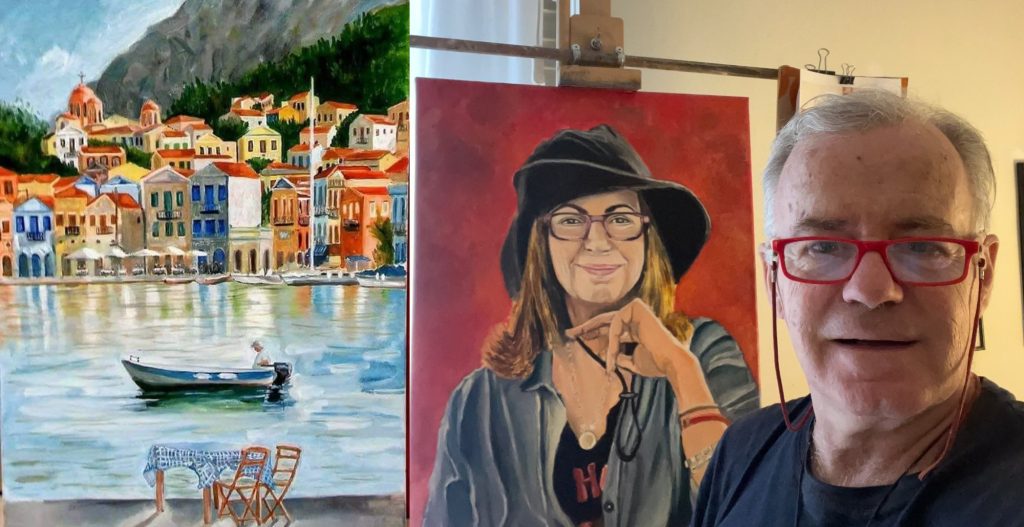
Art often emerges from a lifelong dialogue between experience and perception. In the case of Ioannis Gaitanes, painting represents far more than a creative pursuit. It stands as the culmination of a life marked by resilience, discipline, and an unwavering commitment to beauty. His work reflects the sensibility of an artist who has observed the world with unusual attentiveness and who has transformed personal challenges into sources of insight and expression.
Born in Zografou, Athens, in 1959, Ioannis Gaitanes grew up with a determination that would shape every stage of his life. Although he was born deaf, he never allowed this condition to limit either his ambitions or his engagement with the world around him. Instead, he cultivated a profound awareness of visual experience, developing a relationship with form, colour, and atmosphere that would later find its fullest expression in painting.
Professionally, Gaitanes followed a path that demonstrated both intellectual rigour and dedication to service. He graduated from the School of Dentistry at the University of Athens and embarked upon a distinguished career that spanned more than three decades. For thirty-two years he worked at the Commercial Bank of Greece, later Alpha Bank, first as an employee and subsequently as an auditor dentist. Alongside this role, he maintained a private dental practice in Nea Smyrni for several years. These responsibilities required precision, patience, and meticulous attention to detail, qualities that would later become evident in his artistic work.
Yet throughout these years, painting remained a constant presence in his life. The attraction to art began in childhood and persisted as a quiet but enduring passion. Following his retirement, Gaitanes chose to dedicate himself fully to the pursuit that had long occupied his imagination. Determined to strengthen his technical skills and deepen his understanding of artistic practice, he enrolled at the private School of Fine Arts BORGIA’S, where he studied for two years. This formal training enabled him to refine his approach while preserving the spontaneity and emotional sincerity that characterize his work.
His artistic development soon gained recognition. He participated in two group exhibitions organized by the school, introducing his paintings to a wider audience. Several of his works have since entered private collections, including two in Paris and others in Aegina, Piraeus, Kypseli, and Alimos. Such placements testify to the universal appeal of his art and to his ability to communicate across cultural and linguistic boundaries through the language of visual expression.
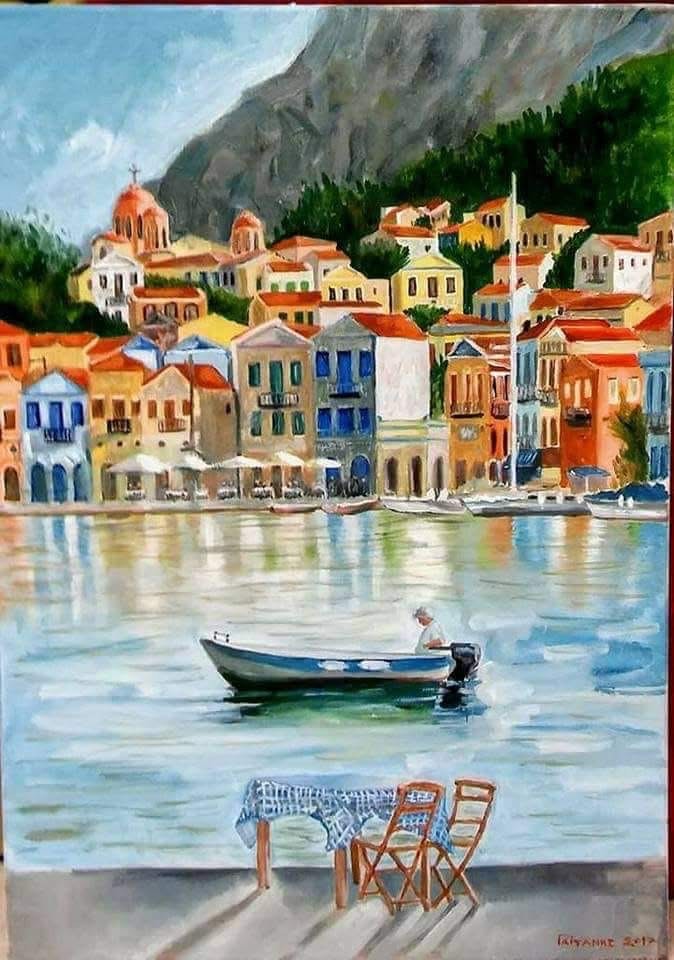
The painting under consideration offers a compelling example of Gaitanes’s artistic vision. It presents a tranquil harbour scene, most likely inspired by one of the picturesque coastal settlements of the Greek islands. The composition captures a moment of stillness where architecture, sea, and human presence coexist in harmonious balance. Rather than emphasizing dramatic action or narrative complexity, the artist invites the viewer into an atmosphere of contemplation.
At first glance, the eye is drawn to the colourful waterfront buildings that rise gently from the shoreline. Painted in warm shades of ochre, cream, terracotta, blue, and coral, the structures form a vibrant mosaic that reflects the distinctive architectural character of the Mediterranean world. Their arrangement follows the natural contours of the landscape, ascending toward a densely wooded hillside and ultimately giving way to the imposing mountain that dominates the background.
This vertical progression from sea to town, from town to forest, and from forest to mountain establishes a sense of depth and permanence. The mountain serves not merely as a backdrop but as a silent guardian overlooking the settlement. Its presence anchors the composition and introduces a note of grandeur that contrasts with the intimacy of the harbour below.
Colour plays a central role in the painting’s emotional effect. Gaitanes employs a palette that evokes warmth, serenity, and luminosity. The red tiled roofs create rhythmic accents throughout the townscape, linking the various buildings into a coherent visual whole. The blues of doors, shutters, and balconies establish a dialogue with the surrounding water, while the pale yellows and creams capture the effect of sunlight upon stone and plaster.
Particularly noteworthy is the artist’s treatment of light. Rather than depicting a specific moment of intense illumination, he creates a diffused radiance that envelops the entire scene. The light appears to emanate from the atmosphere itself, softening edges and lending the painting a dreamlike quality. This approach recalls the Mediterranean tradition of celebrating sunlight not merely as a physical phenomenon but as an emotional and spiritual presence.
The harbour waters occupy a significant portion of the composition and function as both a visual and symbolic element. Their calm surface reflects fragments of the town while introducing subtle variations of blue, green, and silver. Through these reflections, the artist creates a sense of movement without disturbing the overall tranquillity of the scene. The water becomes a mirror that unites the built environment with the natural world.
Near the centre of the painting, a small boat carrying a solitary figure provides the principal human element. The figure appears engaged in a quiet activity, perhaps fishing or simply navigating the harbour. Significantly, the individual is not portrayed as a dominant subject but as an integral part of the landscape. This understated treatment reinforces the painting’s atmosphere of humility and balance. Human life here exists in respectful coexistence with sea, town, and mountain.
The placement of the boat is particularly effective from a compositional perspective. Situated within the broad expanse of water, it acts as a focal point that guides the viewer’s gaze across the painting. Its dark form contrasts gently with the luminous surface of the sea, creating visual stability while maintaining the work’s overall sense of calm.
Equally intriguing is the foreground arrangement of a table and two empty chairs positioned beside the waterfront. These objects introduce a subtle narrative dimension. They suggest recent presence or anticipated arrival. Someone may have just departed, or someone may soon return. The emptiness of the chairs invites viewers to imagine themselves within the scene, transforming them from observers into participants.
The shadows cast by the furniture add another layer of meaning. Their elongated forms indicate the passage of time and contribute to the painting’s contemplative mood. In many ways, the table and chairs function as a threshold between the viewer’s world and the world of the painting. They offer a place of rest from which one may contemplate the harbour and absorb its quiet beauty.
Technically, the work demonstrates Gaitanes’s command of composition and colour relationships. His brushwork balances descriptive detail with painterly freedom. Architectural elements remain recognizable without becoming rigid or excessively precise. The artist understands that the purpose of painting is not photographic replication but emotional interpretation. Consequently, forms are simplified where necessary, allowing atmosphere and feeling to take precedence.
The painting also reveals an instinctive understanding of harmony. Every element contributes to the whole. The mountain does not overpower the town. The town does not overwhelm the sea. The solitary boat does not disrupt the stillness. Instead, each component participates in a carefully orchestrated visual conversation.
Viewed within the context of Gaitanes’s life, the work acquires an additional dimension. As someone who has experienced the world primarily through sight rather than sound, he demonstrates an exceptional sensitivity to visual rhythm and spatial relationships. The painting suggests an artist who listens through observation, who discovers meaning in colour, light, and form. His deafness, rather than constituting a limitation, appears to have deepened his engagement with the visual realm and enriched his artistic perception.
This harbour scene ultimately celebrates more than a specific location. It celebrates a way of seeing. It affirms the value of quiet moments, harmonious landscapes, and enduring human connections with place. Through luminous colour, balanced composition, and a profound sense of serenity, Ioannis Gaitanes transforms an ordinary coastal view into a meditation on beauty and belonging.
His artistic journey from childhood passion to professional accomplishment demonstrates that creativity often matures through patience and perseverance. The painting stands as a testament not only to technical skill but also to a life devoted to overcoming obstacles and discovering meaning through art. In its calm waters, sunlit architecture, and silent atmosphere, one encounters the essence of an artist whose vision continues to inspire and whose work reminds us that beauty often resides in the simplest and most enduring scenes of everyday life.