Speaking of art, we delve into a special artist, Filippo Papa, according to whom and in his words: “Non è solo corpo ma anima, forza e culture”. Filippo Papa has just performed his last holoperformance “Desnudo” in the III Edition Canal´Art 2022, Ajuntament de Santanyí, in Mallorca (Spain), performed for the first time in October 2022 in the “Estudi Garrit”.
“Desnudo” is the new artistic performance by the artist Filippo Papa after “Regeneration” which he re-presented at the Biennale Amedeo Modigliani in Venezia. This new performance is part of the concepts devised and promoted by Papa: Holoperformance with the dematerialization of the body through holography and the use of the “Skin Collage” technique.
The philosophy of the project is based on a detailed study by Papa of the performing arts, of the artistic nude to focus on a specific work “La Maja Desnuda” one of the best-known paintings by Francisco Goya made around 1800. It is a portrait revolutionary, where for the first time the naked body is represented without any mythological reference that justifies its nudity. Its importance, therefore, is not only due to the pictorial technique but also to the symbolic historical primacy that it holds, since “La Maja Desnuda” is portrayed in a seductive attitude with her hands crossed behind her head, a direct gaze and provocative, who is not afraid of being seen is a self-confident woman.
It is true that defining art is a complex and difficult task. Thus, art must be understood as a skill that seeks an aesthetic result (Hatcher, 1999) through imagination to create environments and aesthetic experiences that can be shared with other people. This ability is used to express and manifest the creativity of the artist, to connect and reach the aesthetic sensibility of others.
Since ancient times, especially in Greece, tekné, a term meaning “art”, has developed, representing various artistic activities not related to the visual arts, but rather to poetry, theatre, music, and science. Later, Kant in 1790, proposed various categories of art, such as the bildenden Künste, as the expression of ideas in the intuition of the senses, including painting, sculpture and architecture; the redenden Künste, like the language arts; and the Schönen Kunst Spiels der Empfindungen, the art of the beautiful play of sensations, such as music and colours. In this way, we can define art as a set of related concepts rather than one single concept. More modernly, in the 1910s and 1920s, Marcel Duchamp will introduce the beginning of conceptual art, which will emerge as a movement during the 1960s, and will influence subsequent art movements, developing a broad conceptual art in the 1990s. in Great Britain, which will be developed to create an impact on the basis that the object is not the work of art. In this way, conceptual art is understood as an artistic movement in which the conceptualization or the idea is more important than the work of art as a physical or material object, where ideas prevail over its formal and sensible aspects, and where artistic is the concept to represent, indifferent to the technique, form, and material. Initially, a conceptual work is based on textual language to convey ideas, although it will evolve and be complemented by other resources from the visual field, including photography and performance, closely adapting it to contemporary art.

Among all these evolutionary processes, we can talk about body art, this is going to be a style framed in conceptual art, using the body as a plastic material. In body art, the body is the support of the artistic work, painting it, decorating it, tattooing it, modifying it, etc. This action, which we can call performance, is generally carried out with a photographic, videographic, holographic, poetic, pictorial accompaniment or other means, all or part of them, used during or after the performance. Body art stands out for the abject aspects of the body, marking strong contrasts, including clothing and the nude. It is here that the body becomes a work to create art, the body itself is the work of art, expressing the acceptance of one’s own individuality and establishing connections with related ideologies and certain social movements. Since the fundamental focus is on the body, it conditions viewers to understand and focus on their own concepts of the physical. Body art will also have a close relationship with questions of gender and personal identity, while delving into themes of the relationship between the body and the psyche, expressed in the body.
Papa’s intention is complex and ambivalent, personifying “il Filippo desnudo” he wants to draw attention to the importance of the artistic nude and uncensored art, a mission that has been going on for years with the “Naxed” project, to reinforce this concept, also Five photographic/performative artistic nudes from the “In the room” project, already presented in Spain, were exhibited. In addition, he wants to launch a message of gender fluidity to educate the vision of the figure of a male artistic nude that is still considered unusual today. Nudity is part of our human being, the male and female nude body is universal, like its beauty.

Thus we come to performance or action art, a term derived from the English performance art, meaning live art, as a form of free expression that emerged to be an alternative artistic manifestation, an avant-garde art developed extensively throughout the 20th century and early 21st century, an art form created through actions performed by the artist, alone or with other participants, live performance, closely documented, following a pre-written script, or spontaneous, presented in an interdisciplinary manner to an audience within an exhibition context. Its first manifestations arise in 1916, welcomed under the conceptual art of the Dadaist movement, responding to artistic purposes and the desire to experiment with new avant-garde trends. The performance needs the presence and execution of the artist himself, involving four basic elements: time, space, the body or the presence of the artist in a medium, and the relationship between the creator and the public. The performances are usually developed in art galleries, museums, cultural centres, and bookstores, although they can take place in any type of setting or space and during any period of time. The themes represented are usually linked to the experiences and ideas of the artist himself, who makes actions emerge through improvisation and a sense of aesthetics with the aim of generating a reaction from the public. Performance is related to Western postmodernism and culture linked to concepts of visual art, being an antithesis of theatre and challenging established art forms, since it is born from an antagonistic and critical position towards the performing arts, since performance differs from the formal narrative idea of other performing arts, linking more to the fine arts, far from any idea of scenic representation as a unique and sublime ephemeral experience. Some artists are closer to the experimental idea, where performance can intertwine many more disciplines, including any type of performing art, such as dance, theatre, poetry or music. In performance, the interpreter is the artist who rarely represents a character as an actor and the content does not follow a traditional plot. The performance will show tiny gestures for a few minutes to many hours, it can be performed once or repeated many times, with or without a prepared script, spontaneously improvised or previously rehearsed. The performance escapes beyond the fact that it is living art made by artists, since it resorts to very diverse disciplines and means of communication, in fact, no other form of artistic expression has such an unlimited manifestation, since each performer makes his or her particular definition in the process and manner of execution.

The artist Papa undresses on a sofa in the same pose as “La Maja Desnuda”, in a pose that emulates showing off behind a screen as on social networks. The nudity of his body will be seen simultaneously both in reality and fragmented, dematerialized through the projection of a holographic video. During the performance Papa will apply the word “NUDE” in 12 languages on the body using the technique that he devised the “Skin Collage” to further emphasize his message by printing it on his skin that will be “dressed” in nudity.
In the mid-1960s, Process art emerged, an artistic movement within the field of study of performance, where the art object is not the main focus of attention, but rather a process of art formation such as the search for and the creation of concepts adherent to the work, as well as the ephemerality of the work itself, concerned with the real «doing»; art as performance. Therefore, art is seen as a creative journey or process, rather than the finished product. On the other hand, in 1982 the joint form of poetry and performance appears, emerged to distinguish vocal interpretations based on the word of artistic interpretations, especially the works of scenic or musical performance artists. Performance poets rely more on the rhetorical and philosophical expression of their poetics than performance artists of the visual arts genres.
The performer Filippo Papa reworks Goya’s “La Maja Desnuda” in a new interpretation, which is still talked about today. In “Desnudo” we find the union between the history of art, the performative act and contemporary technology. Careful work in the unmistakable style that Papa has accustomed us to see.


 As Greece is a sea-fairing country, it was customary in many households on the islands and on the coast to decorate a wooden ship, which symbolizes the new direction that the birth of Jesus gives to human life. It was gradually replaced by the Christmas tree with the reign of Otto I, the first king of Greece in 1832. Recently, more people and municipalities are bringing back the custom of decorating a ship in place of the Christmas tree.
 The Christoxylo (Christmas wood) is burned throughout the festivities in the countryside areas of Greece. It burns from Christmas Eve until Epiphany. This is to stop the Goblins from creating havoc as they are only afraid of fire until, with the sprinkling of the Holy Water on Epiphany Day, they are forced to return to the depths of the Earth.
 Besides the Christmas Kalanta that are sung by groups of children from house to house, many poems with the theme of the birth of Jesus Christ have been written by well-known Greek poets. One such poem is the following written by Kostis Palamas (1859-1943), the Patriarch of Modern Greek poetry and author of the Olympic Anthem. He was a leading figure in the literary world of the 1880s. He explores the post-classical and post-Byzantine Greek world. Palamas’ strong religious and liturgical connotations, unifies spiritual, philosophical, and historic notions of Hellenism. The divine birth is a recurring theme in Palamas’ poetry, a spiritual celebration of redemption and humility. His poem ‘Christmas’ is well-known and much loved.

 The Greek refugees that came from Asia Minor and settled in Greece often named their new townships after their places of origin. This is the case of Palaia Phocaea, the ancient Greek city on the Aegean coast of today’s Turkey. They left their ancestral homes and sought refuge in Motherland Greece after the disintegration of the Ottoman Empire, the end of World War I, and the rise of Kemal Atartouk, which led to the genocide of the Christian populations as well as the burning of Smyrna in September 1922.
  The history of Phocaea is a long and turbulent one, from the Greco-Persian conflict in 546 BC through to Roman and Byzantine rule when it was given to Benedetto Zaccaria, the Genoese ambassador to Byzantium as a hereditary lordship in 1275. It remained a Genoese colony until it was taken by the Turks in 1455. Constantinople fell to Sultan Mehmed II on May 29, 1453.
  The documentation and photographs of the French engineer and archaeologist Felix Sartiaux (1876-1944) have helped to bring these atrocities to light as they describe the sequence of events before and during the massacre. He and his three assistants took measures to help the Greek population by hoisting French flags on their homes and thus provided shelter for the refugees.
  Despite the attempts to be reimbursed by the Turkish government for the properties that had been left behind, this was not possible. The refugees had to put an end to their dreams of ever returning to their homeland and to concentrate on creating a future for their families in Greece. They therefore set about building their church and their school. The first church was founded in 1932 and was dedicated to Saint Irene, as was the church in Palaia (Old) Phocaea of Asia Minor. In June 1947, the official decision was taken by the government for the founding of the independent community of Old Phocaea.
 In this context, we can speak of poetry, characterized by the close interaction of verbal and visual language, where the image accompanies the verse, while the visual discourse of the image interacts with the word to elaborate the poetic world. The visual appeals to emotion through action, while poetry, in turn, emphasizes the predominance of a verbal register, both fields focused on philosophical and intimate reflection, with a message that is wanted to be transmitted both with the word and with the visual. From this interaction of verbal and visual signs, a sense is born and develops that establishes a synergy and a relationship of interdependence, that is, constituting an indivisible and unalterable aesthetic and formal unit.
 Poetry is characterized by its internal cohesion, its rhythmic and sound qualities, the predominance of poetic connotation, a meaning, freedom, expressive and linguistic creativity, linking with the artistic dimension characterized by its interpretive qualities, emotion and sensitivity. , expressive creativity and the aesthetic part of art. In this way, both expressive elements (verbal and visual) form an aesthetic unit and converge in the construction of meaning, resulting in a work made of words and images.
 Analysing the various aspects of poetic language and visual art, we can see that there is an innovative journey that goes from poetry to image and performance, or on the contrary, from visual art to poetic language. The two have always had a very close relationship. In this way, we can say that “art is silent poetry and poetry is speaking art”, as Simónides of Ceos (VI-V BC) already expressed and later Horace placing poetry dependent on the image.
 Anika Gupta is 8 Years old, in 2nd grade. She lives in USA. She is a brilliant student (throughout A+). She loves art, reading, and is very curious to know and learn about new things. She has participated in many countries- Azerbaijan, Brazil, Dominican Republic, India, USA, Iran, Ecuador, Egypt, Mexico, Peru, Tunisia, Turkey, UK, Ukraine etc. Recently she participated in many international online art events/ exhibitions like Guinness Book of World record event.

 Records, Extraordinaire World Record Holder, Marvelous Book of Records Holder, India Records Holder, a freelance artist, curator is originally from India, now based in Florida, USA for almost 2 decades. She has a Ph.D. in Drawing & Painting from the University of Rajasthan. Jaipur, India. Her topic for Dissertation was, “Leisure in the Arts through the Ages: A comparative study of the themes on Leisure in Indian and European Painting with special reference to 16-19th century” (2006). She did her M.A. in Drawing & Painting, where she was the University Topper and Gold Medalist, with First Division & First Position (1997-1999). She also holds a degree in B.F.A. (Painting), from Rajasthan School of Arts, Jaipur, India (1993-1997). Mahima was a proud recipient of the prestigious University Grants Commission of India (UGC) Junior & Senior Fellowship for Doctoral work (2000-2005). She was also awarded the Rajasthan Lalit Kala Akademi Student Scholarship (1998-1999). Mahima was awarded at the 10th Kala Mela organized by the Rajasthan Lalit Kala Akademi, Jaipur, India (2002). Also awarded at the All India Exhibition of Arts, by Indian Academy of Fine Arts, Amritsar, India (2001). Mahima is a proud recipient of the Bhoor Singh Shekhawat Memorial Padamshree Kripal Singh Shekhawat Award (1998).

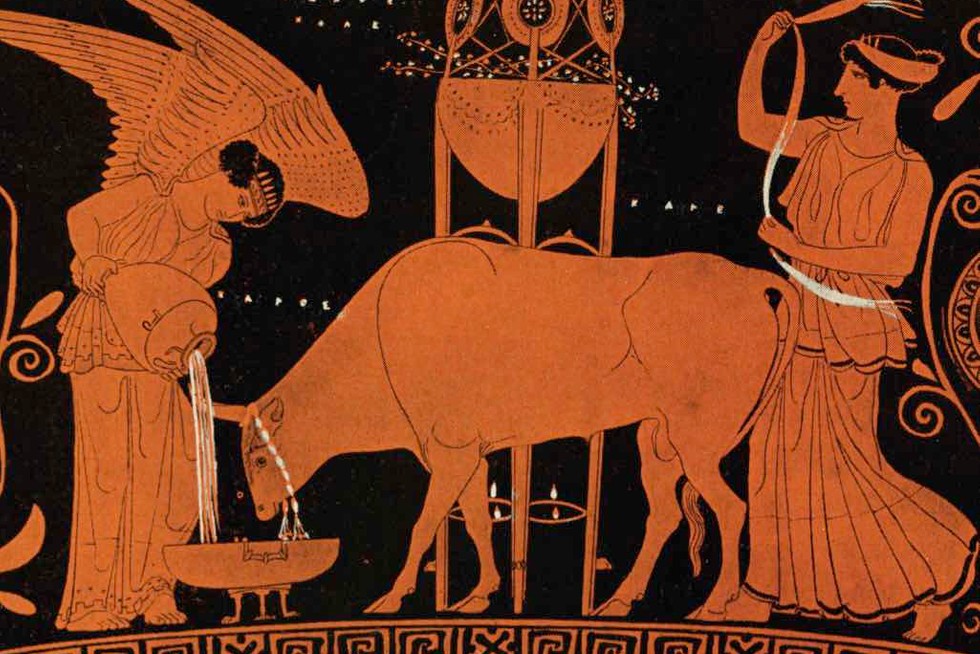
 The month of May is named after the ancient Greek goddess Maia, the goddess of fertility and re-birth. Maia was the daughter of Atlas (the Titan condemned to hold up the celestial heavens for eternity after the Titanomachy) and Pleione, the Oceanid nymph. She lived by herself in a cave on Mount Cyllene in Arcadia. She was the eldest of the seven Pleiades that make up the Pleiades star cluster in the constellation of Taurus. Zeus secretly slept with Maia and she gave birth to Hermes, the god of trade, merchants, commerce, roads, thieves, etc. Hesiod, in his Theogony, refers to this: And Maia, the daughter of Atlas, bore to Zeus glorious Hermes, the herald of the deathless gods, for she went up into his holy bed. Besides giving birth to Hermes, Maia raised the infant Arcas, son of Zeus and the nymph Callisto. The Prefecture of Arcadia in the Peloponnese is named after him. In Greek, Maia means midwife. Aeschylus, the ancient Greek tragedian, identifies Maia the nursing mother with Gaia, the Earth.
 The photograph of the mother of Tasos Tousis, one of the strikers, lamenting over the body of her dead child as it lay on a makeshift stretcher that his co-workers had put together, inspired the poet Yiannis Ritsos to write the poem Epitaphios. The scene brought to mind the lament of Virgin Mary over the body of Christ when he was brought down from the Cross. Yiannis Ritsos wrote Epitaphios in ten days. He sent it to Mikis Theodorakis in 1958 who put it to music. The songs were first sung by Grigoris Bithikotsis. The work Epitaphios was basically banned from being performed publicly until 1974 when Democracy was reinstated in Greece after the fall of the Junta and the imprisonment of Colonel Papadopoulos and the other army offices involved in the enforcing of the dictatorship between 21 April 1967 and July 1974.
 I grew up in Sydney Australia and as a teacher of English, writing has always been a part of my life. I have always been interested in the history, culture, and traditions of my country of origin, Greece. After my marriage I had the opportunity to return to Greece and settle in Athens. This enabled me to travel around Greece and gave me the incentive to write short articles about the different places I visited, trying to highlight the history as well as the traditions and the mythology that relates to them. I began my blog: Greece through Despena’s Eyes so that my articles could be read by those who had an interest in Greece.


