Divine Dialogues: Series of Ancient Scriptures in Poetry – Kathopanishad by Dr. Srilakshmi Adhyapak, published in 2024 by Writers International Edition, is a remarkable poetic retelling of one of India’s most profound philosophical texts, the Kathopanishad. This 76-page volume, part of the Krishna Yajurveda, transforms the ancient dialogue between the young seeker Nachiketas and Yama, the god of death, into a lyrical exploration of life, death, and the eternal Self (Ātman). With an ISBN of 978-93-94182-78-3, the book is printed by Manipal Technologies Limited and designed by Black Innovations, Delhi. Dr. Adhyapak, a medical professional and poet, offers a unique contribution to spiritual literature, blending Vedic wisdom with poetic elegance. Enhanced by a foreword from Dr. Lakshmi Bandlamudi and a study by Preeth Padmanabhan Nambiar, this work bridges ancient philosophy and modern readership, making it a significant addition to the canon of Upanishadic interpretations.
Structure and Presentation
The book is thoughtfully structured, beginning with introductory sections that provide context and scholarly insight. A foreword by Dr. Lakshmi Bandlamudi, a professor at the City University of New York, titled “Retelling of Dialogues with Death: A Poetic Rendition,” situates the work within the tradition of dialogues with death, drawing parallels with Sri Aurobindo’s Savitri. This is followed by a detailed study, “From Silence to Song,” by Preeth Padmanabhan Nambiar, President of Writers Capital International Foundation, which analyzes Dr. Adhyapak’s translation approach. The preface and acknowledgments by the author offer personal reflections on her motivations and gratitude, particularly to her family and mentors. The core of the book, spanning pages 29–76, presents the poetic rendition of the Kathopanishad, composed in quatrains with a consistent rhyme scheme.
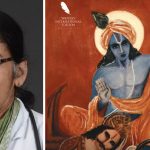
The publication is aesthetically pleasing, with a cover featuring an evocative painting by Dr. Sreekar Balasundaram depicting Nachiketas and Yama in conversation. The design is clean, though minor typographical errors, such as “Rathopanishad” on early pages, slightly detract from the professional finish. The book’s compact length ensures accessibility, while its scholarly apparatus—foreword, study, and preface—adds depth for readers seeking critical engagement.
Thematic Depth
The Kathopanishad is renowned for its exploration of existential questions, particularly the nature of the Self and what lies beyond death. Dr. Adhyapak’s rendition captures these themes through a poetic lens, emphasizing the dialogue’s spiritual and philosophical core. The narrative follows Nachiketas, a young seeker who, after being offered to death by his father in a moment of anger, confronts Yama with three boons. His final request—to understand the nature of existence beyond death—leads to profound teachings on the eternal Ātman, the distinction between śreya (the good) and preya (the pleasant), and the path to liberation (moksha).
Key themes include:
-
The Quest for Truth: Nachiketas’s unwavering resolve, as seen in lines like “Placid as a lake of waves devoid, / Steadfast he stood, swirling mirages in a diaphanous void,” underscores his rejection of material temptations for spiritual knowledge.
-
The Eternal Self: The Ātman is depicted as “neither birth nor death doth touch, / Eternal, un-decaying beyond mortal clutch,” emphasizing its timeless, unchanging nature.
-
Fire as Knowledge: The symbolism of fire, particularly Nachiketas’s fire ritual, is rendered as “Knowledge of fire akin to texts sacred, / Primordial, blazing before creation’s origin in fiery red,” symbolizing divine wisdom and purification.
-
Self-Realization: The chariot metaphor—where the body is a chariot, the intellect the charioteer, and the senses the horses—is poetically evoked, urging disciplined control for spiritual ascent.
Dr. Adhyapak’s poetry also engages with the Upanishad’s ecological and universal vision, likening the Self to natural elements like water and air, which “assume bodies in diverse tentacles” yet remain unified.
Poetic Craft
Dr. Adhyapak’s translation is not a literal rendering but a poetic reinterpretation, prioritizing lyrical flow and spiritual resonance over strict fidelity to the Sanskrit original. Her use of rhymed quatrains creates a rhythmic cadence, reminiscent of oral traditions, as noted by Bandlamudi’s reference to “Ananta Tala – The Eternal Rhythm.” The language is rich with metaphors—“Upanishad a trisyllabic word, / Of pregnant knowledge, a seeker’s sword”—and vivid imagery, such as “Fire lit with sticks wooden, / Lighting the path to heaven golden.”
Her style balances accessibility with depth, making complex Vedantic concepts approachable. For instance, the duality of śreya and preya is captured in “Twin paths flow in ways diverse, / Mutually exclusive, like opposites reverse,” offering clarity without sacrificing nuance. The absence of punctuation in some verses mirrors the fluidity of Upanishadic thought, though it may challenge readers unfamiliar with such conventions.
Strengths and Considerations
The book’s primary strength lies in its ability to make the Kathopanishad accessible to a contemporary audience. Dr. Adhyapak’s medical background informs her preface, where she reflects on life and death as “two sides of the same coin,” adding a personal dimension to her scholarly endeavor. The foreword and study enhance the work’s credibility, situating it within broader literary and philosophical discourses. The poetic form, with its mellifluous language and meditative tone, invites readers to engage with the text as both literature and spiritual guide.
However, the work is not without limitations. The poetic license taken may diverge from the original Sanskrit’s precision, potentially distancing purists who prefer prose translations like those of Swami Vivekananda or S. Radhakrishnan. Additionally, the dense philosophical content, while beautifully rendered, may require familiarity with Vedic concepts for full appreciation, though the introductory sections mitigate this challenge.
Cultural and Literary Significance
Dr. Adhyapak’s Divine Dialogues is a significant contribution to the global dissemination of Upanishadic wisdom. Published by Writers International Edition, with offices in Mysore, India, and Athens, Greece, the book reflects a cross-cultural effort to preserve and reinterpret Indian spiritual heritage. Its alignment with the mystical fervor of Tagore’s Gitanjali and Sri Aurobindo’s Savitri positions it within a lineage of poetic spirituality. The work’s emphasis on self-inquiry and detachment resonates in a modern world often preoccupied with materialism, as Nambiar notes in his study.
The book also highlights the role of women in Vedic scholarship, with Dr. Adhyapak joining a growing cohort of female voices reinterpreting sacred texts. Its publication under Writers Capital Foundation, known for fostering literary talent, underscores its cultural importance, particularly within the context of the Panorama International Arts & Literature Festival.
Conclusion
Divine Dialogues: Kathopanishad by Dr. Srilakshmi Adhyapak is a luminous poetic rendition that breathes new life into an ancient text. Through its evocative imagery, rhythmic elegance, and spiritual depth, it captures the essence of the Kathopanishad’s teachings on the eternal Self and the path to liberation. While minor editorial oversights and the poetic approach may not suit all readers, the work’s accessibility, scholarly framing, and universal appeal make it a valuable resource for those interested in spirituality, poetry, and Indian philosophy. Dr. Adhyapak’s offering is a bridge between ancient wisdom and modern sensibilities, inviting readers to contemplate the timeless question: what lies beyond the veil of death?