Writers International Edition

Articles

The Artistic Journey of George Anastasiadis: A Confluence of Healing and Creativity

George Anastasiadis, born in the vibrant city of Thessaloniki on November 11, 1968, embodies a unique fusion of art and healing. As a dedicated physical therapist working in a public rehabilitation center for individuals with disabilities, George’s career is devoted to helping others recover and regain their strength. Yet, beneath this professional facade lies a passionate painter, self-taught and driven by a profound need to express his inner world through art.

In his formative years, George was fortunate to have the mentorship of Nikos Paralis, a teacher whose influence ignited his creative spark during high school. Under Paralis’s guidance, George discovered the transformative power of painting—a medium that allows him to communicate the depths of his subconscious. His works are not merely aesthetic creations; they are profound statements that delve into the complexities of human existence, each canvas serving as a repository of emotions, thoughts, and reflections.

What distinguishes George’s art is the intricate interplay of symbols and messages woven into his paintings. As a surrealist, he draws inspiration from the hidden layers of reality, capturing fleeting moments that often go unnoticed. Each stroke of his brush is an automatic expression of his subconscious, unveiling a landscape rich with metaphor and meaning. Through his work, he reveals the complexity of life, offering viewers a glimpse into his soul, where he believes every piece of art conceals “a little piece of the soul.”

For George, painting transcends the act of creation; it becomes a form of confession, a means of communication with the world around him. In this dialogue, he explores the notion that everything in existence is interconnected, an indivisible whole. He reflects on the transient nature of life, observing how everything can stagnate, wear down, and ultimately fade away. Yet, amid this ephemerality, George emphasizes the harmony that exists within the universe. He believes we are immortal elements, each of us an integral part of a larger cosmic tapestry. This perspective imbues his art with a sense of simplicity and authenticity, as he seeks to convey that nothing in life is absurd or frightening; rather, it is a reflection of our inherent nature.

Driven by an inner desire for self-discovery and improvement, George’s artistic pursuits are intertwined with his philosophical, rational, and metaphysical explorations. His journey is not solely about creating art but also about evolving into a better version of himself. Through each painting, he embarks on a quest for understanding and personal growth, making his artistic practice a vital component of his overall well-being.

Over the years, George has actively participated in numerous exhibitions, showcasing his work to audiences both locally and beyond. His dedication to his craft has not gone unnoticed, as he has received multiple awards, affirming the impact of his artistic voice within the community. Each accolade serves as a testament to his commitment to art and healing, illustrating the profound connections between creativity, therapy, and the human experience.

In a world often marked by chaos and uncertainty, George Anastasiadis stands as a beacon of hope and inspiration. His journey as both a physical therapist and a self-taught painter exemplifies the power of art to heal, connect, and transform. Through his works, he invites us to explore the depths of our own souls, to recognize the beauty in simplicity, and to embrace the interconnectedness of all beings. As he continues to evolve as an artist, George remains dedicated to his dual mission of healing and creation, leaving an indelible mark on all who encounter his work.

The Artistic Journey of George Anastasiadis: A Confluence of Healing and Creativity Read More »

The Artistic Odyssey of Kate Panagou-Stavrakoudi: A Journey of Philosophy, Expression, and Compassion

Kate Panagou-Stavrakoudi, an accomplished artist born in Istiaia, Euboea, Greece, has woven a remarkable journey between the realms of education and art. A graduate of the prestigious Faculty of Philosophy at Aristotle University of Thessaloniki, Kate dedicated over three decades to secondary education as a philology teacher, a role that allowed her to nurture the minds of countless students while simultaneously nurturing her own artistic spirit. Her journey into the world of painting was not guided by formal training but rather by an innate, profound passion. In many ways, her mind and soul have served as her mentors, and her work is a testament to this pure, self-taught artistry.

Kate’s oeuvre defies the constraints of a singular technique or style. Her art spans the spectrum, from realism to surrealism, with deeper ideological and philosophical undertones, and to the bold dynamism of abstract expressionism. This fluidity in her expression is matched by her dexterity in various mediums; she works masterfully with oils, acrylics, watercolors, and other mixed media. Each piece she creates is not just a reflection of her talent but an exploration of thought, emotion, and the intricate nuances of human experience.

Her active involvement in the artistic community is as extensive as her portfolio. As Treasurer of the Board of Directors of the visual arts association “Apellis,” a member of the Panhellenic Union of Writers and Artists (PELΤ), and an affiliate of artists’ unions such as “Dione” and “Kallitechnorama,” Kate has contributed significantly to Greece’s cultural tapestry. Her participation in these associations highlights her commitment not only to her personal artistic journey but to the broader artistic community, where she plays an influential role.

Kate’s work has been exhibited far and wide, with over seventy group exhibitions under her belt, both in Greece and internationally, including in Cyprus and Austria. In addition, she has held three solo exhibitions in Chalkida, where her unique voice as an artist has resonated deeply with viewers. Her global presence has been further expanded through her participation in online exhibitions in Chile, Egypt, Syria, and Libya, where she has proudly represented Greece. Such platforms have allowed Kate to extend her reach, sharing her vision with an international audience while forging connections with artists and art lovers worldwide.

Her artistry has not gone unnoticed. Kate’s work has been featured in prominent artistic calendars, and her paintings have been immortalized in books, television interviews, newspapers, and online media outlets. The esteemed blog “Homo Universalis” has also showcased her art, elevating her profile within the global arts community. Notably, many of her pieces have garnered distinction in international groups, reflecting her growing reputation as an artist of global relevance. One of her celebrated works, “Broken Ship,” has found a permanent home in the Museum-Archive of the renowned Chalkida surrealist poet and writer G. Skarimbas—a testament to the lasting impact of her creative vision.

Beyond the aesthetic and philosophical depth of her work, Kate Panagou-Stavrakoudi has consistently demonstrated a spirit of compassion and generosity. She has donated numerous artworks to various charitable causes, including the Agios Savvas Hospital, the Hatzipaterio Foundation, the I. Metaxas Hospital, and the Smile of the Child organization. Her commitment to using art as a tool for healing and support highlights her deep empathy and unwavering dedication to humanitarian causes. This fusion of art and philanthropy positions her as not only a skilled artist but also as a figure of profound social impact.

Kate’s legacy extends into private collections, where her works continue to inspire and provoke thought. Her unique ability to weave complex philosophical ideas with evocative visual forms ensures that her art will remain a source of contemplation and admiration for years to come. Through her expansive career, Kate Panagou-Stavrakoudi has firmly established herself as a vital voice in contemporary art, one that bridges the gaps between philosophy, emotion, and humanitarianism, all while maintaining an unwavering commitment to artistic excellence.

The Artistic Odyssey of Kate Panagou-Stavrakoudi: A Journey of Philosophy, Expression, and Compassion Read More »

Lavinia Antonia Coșovliu: A Journey Through the Canvas of Time

Lavinia Antonia Coșovliu stands as a distinguished figure in the Romanian art scene, a painter whose vibrant career spans decades and whose works have transcended national boundaries, leaving a mark on the world of visual arts. Born on June 10, 1958, in Brăila, Romania, Coșovliu has nurtured a deep connection to the arts from an early age, a passion that she honed into a lifelong pursuit of artistic excellence.

Lavinia Coșovliu’s artistic journey began in the nurturing environment of the Liceul de Muzică și Arte Plastice Galați, where she studied from 1973 to 1977. This early foundation in music and visual arts shaped her multidisciplinary approach and set the stage for her future explorations in fine arts. Later, she pursued further academic studies at the Facultatea de T.C.P.A.T.P., between 1983 and 1988, expanding her artistic horizon with a deeper understanding of technical, theoretical, and practical aspects of artistic creation.

Her commitment to education didn’t stop there. In 2018, Lavinia embarked on yet another educational journey by enrolling in the Facultatea de Arte at the Universitatea “Dunărea de Jos” Galați, specializing in Easel Painting. Completing this degree in 2021, she continued to refine her technical skills and conceptual depth, demonstrating an insatiable curiosity and a desire to push the boundaries of her own creativity.

Lavinia Coșovliu’s career is as prolific as it is diverse, with her works featured in numerous solo and group exhibitions across Romania and beyond. Her participation in various art salons, biennales, and exhibitions has not only showcased her versatility but also affirmed her as an influential presence in the artistic community.

In 2024, Lavinia will grace the prestigious Panorama International Arts Festival (PIAF), an event renowned for its global outreach and dedication to fostering humanitarian values through art. This opportunity is a testament to her ability to communicate powerful messages through her paintings and connect with audiences on an international level.

The year 2024 will also see Lavinia participate in other prominent exhibitions, such as the Salonul de Artă “Meandre Cromatice” in Chisinau, Moldova, and the Salonul de vară hosted by UAP Galați. Her works will continue to engage diverse audiences, offering them a glimpse into the richness of her artistic vision.

Lavinia’s artistic endeavors in 2023 were marked by a series of successful exhibitions, each highlighting a different facet of her creativity. She held a personal exhibition titled Secvențe at the Nicolae Mantu Gallery in Galați, where her work captured the attention of both critics and art enthusiasts. Furthermore, she contributed to the Salonul Național de Arte Vizuale “Interferențe” in Botoșani, which focused on the interplay of different artistic styles and expressions, showcasing Lavinia’s ability to blend traditional and contemporary forms seamlessly.

One of the highlights of her 2023 exhibitions was her participation in the Expoziția Concursului Internațional de Creație Vizuală “Dialoguri Interculturale și Artistice”, an event that brought together artists from different cultural backgrounds to explore the theme of intercultural dialogue through visual art. Lavinia’s work, with its unique blend of Romanian cultural heritage and modern artistic techniques, stood out as a beacon of artistic innovation.

In 2022, Lavinia’s participation in the Bienala Internațională de desen in Arad and the Bienala Internațională de Artă Contemporană “Ion Andreescu” in Buzău demonstrated her growing influence on the international stage. These exhibitions allowed her to showcase her drawings and contemporary artworks, which combine delicate lines with bold expressions, and earned her accolades for her exceptional contributions to modern art.

Her achievements in 2022 were crowned with the Premiu de excelență at the Bienala Națională de Artă “Camil Ressu” in Galați, a prestigious recognition of her artistic excellence and contribution to Romania’s cultural landscape.

Lavinia Coșovliu’s art is deeply rooted in her exploration of the human condition, the relationship between reality and perception, and the emotional depths that lie beneath the surface of everyday life. Her use of color, texture, and form is both evocative and thought-provoking, creating a dialogue between the viewer and the artwork that transcends language and cultural barriers.

Her works often draw from her personal experiences and emotions, while also engaging with universal themes such as identity, memory, and spirituality. Lavinia’s ability to infuse her paintings with a sense of poetic realism allows her to create pieces that are not only visually striking but also rich in meaning.

Throughout her career, Lavinia has remained committed to fostering cultural dialogue through her art. She has participated in numerous projects and exhibitions that promote intercultural exchange and collaboration, reflecting her belief in the power of art to bridge divides and bring people together. Her participation in international exhibitions and festivals is a testament to her dedication to this cause, as she continues to use her art as a platform for cultural understanding and global connection.

As Lavinia Antonia Coșovliu continues to evolve as an artist, her legacy grows stronger with each brushstroke and each exhibition. Her contributions to Romanian and international art are a reflection of her passion, her vision, and her unwavering commitment to artistic excellence.

In a career that spans over four decades, Lavinia has not only honed her technical skills but has also developed a unique artistic voice that resonates with audiences far and wide. Her work, imbued with emotional depth and intellectual rigor, will undoubtedly continue to inspire future generations of artists and art lovers alike.

As we look forward to her upcoming exhibitions in 2024 and beyond, Lavinia Coșovliu remains a shining example of the enduring power of art to shape our world, provoke thought, and touch the soul. Through her art, she invites us all to reflect on the beauty of life, the complexity of the human experience, and the infinite possibilities of creative expression.

Lavinia Antonia Coșovliu: A Journey Through the Canvas of Time Read More »

A Renaissance Soul: Ioanna Ioannidi’s Multifaceted Pursuit of Art and Education

Ioanna Ioannidi, a luminous figure born in the historic city of Argos and now residing in Aria, Nafplio, embodies a remarkable synthesis of art, education, and personal passion. Her journey is a testament to the rich tapestry that can be woven from a diverse array of interests and talents.

Ioanna’s academic path began with a degree in Plant Production from the Faculty of Agriculture, laying a strong foundation for her lifelong connection to nature. This academic background seamlessly dovetailed with her career as a pedagogue, where she specializes in kindergarten teaching. Her commitment to nurturing young minds is further exemplified by her diploma in children’s outdoor activities, underscoring her dedication to integrating nature into early education.

Currently, Ioanna is immersing herself in the visual arts at the Painting Department of the Institute of Argolida. Her artistic exploration does not stop there; she is also deeply involved in Hagiography through classes at the Argos Art Workshop, under the mentorship of Mr. Rigas Rigopoulos. This dual engagement in contemporary and traditional art forms reflects her broad artistic vision and respect for cultural heritage.

Ioanna’s pursuit of knowledge is continuous and multifaceted. She has participated in seminars addressing crucial topics such as the sustainable management of environments for refugees and strategies for overcoming dyslexia. Her educational journey is complemented by seminars on nature, art, culture, and environmental education, each contributing to her holistic approach to teaching and creative expression.

Her engagement in cultural and educational activities extends to theater festivals, conferences, and seminars on a range of topics including theater education, mental health, nutrition, and child protection. These experiences highlight her commitment to integrating art with social and educational issues, using her platform to advocate for positive change.

Ioanna’s artistic achievements are equally diverse. She has showcased her work in group exhibitions and contributed to significant projects like “Prevention through Art” and “Children’s Rights with Fairytale Routes, Songs & Visual Creations.” Her literary contributions include the children’s book “The Naughty Cat” and the evocative poem “Wind Your Breath,” reflecting her ability to communicate profound ideas through various forms of artistic expression.

Beyond her professional and artistic pursuits, Ioanna has a deep passion for music, dance, theatre, pottery, photography, and floristry. This wide array of interests enriches her creative output and personal life, embodying a Renaissance spirit that seeks to explore and embrace the full spectrum of human experience.

Ioanna Ioannidi’s journey is a compelling narrative of integrating diverse fields into a cohesive and impactful life. Her commitment to art and education, combined with her passion for continuous learning and cultural engagement, makes her a truly inspiring figure in today’s multifaceted world.

A Renaissance Soul: Ioanna Ioannidi’s Multifaceted Pursuit of Art and Education Read More »

The UAE ‘s artifice and civilizations

“By sharing our cultural achievements with the world, we build bridges of understanding and appreciation across cultures”.  The Sheikh Zayed Foundation’s words. This foundation is dedicated to preserving and promoting the legacy of Sheikh Zayed Bin Sultan Ai Nahyan, the UAE’s founder Father. emphasizes several key messages related to art and culture.

Over the past decade, art and culture have become increasingly significant in the UAE, it reflecting the nation’s border goals of cultural diversification, economic development, and global recognition.

Cultural identity and national pride both in the UAE are deeply inter twined with its history, traditions and modern achievements. Historical Legacy, cultural festivals and celebrations, Traditional Ats and Craft, Architecture, Cultural Institutionas, Language and literature, cuisine, national symbols, and cultural Diplomacy these elements collectively contribute to a strong sense of cultural identity and national pride in the UAE, celebrating both its rich heritage and modern achievements.

The Vice President and Prime Minister of the UAE and Ruler of Dubai Sheikh Mohammed bin Rashid Al Maktoum has been a significant advocate for cultural development. Under his leadership Dubai has launched numerous cultural projects, including the Dubai Culture &Arts Authority and Dubai Opera.

 Growing up in the Middle East- especially during 90’s – art was for those that could afford to travel. Rarely was a Middle Eastern country considered a go – to spot for the arts. It is now safe that there are a few

Middle Eastern countries invested in the arts, like Saudi Arabia, Jordan and Qatar, with the UAE at the forefront. The UAE was the first Gulf state to have a permanent pavilion at the International Arts Exhibition La Binnale di Venezia and is gaining global traction for its homegrown arts scene. Projects like the Louvre and the Guggenheim- due to open soon in Abu Dhabi- are a natural progression for an emerging cultural hub like the UAE. Yet few publications investigate these developments thoroughly.

Bait al Banat Women’s Museum is all about shining a spot tight on the power of the female in the region.  

Exhibits in the museum, whose Arabic name means ‘’The Girls ‘House,’’ cover the lives of individual women including artists, activists and scholars. These displays give a deep understanding of their subjects’ work, their outlooks and how they lived, via images, interviews personal items, letters and diaries. Offering an insight into the history of Emirati women and their role in the country ‘s development, exhibits in the museum cover the lives of individual women including artists, activists and scholars.

Article by
Preetha VR

About the Writer

Preetha VR is a passionate educator with over 25 years of experience working with children aged 3 to 12 years. An Abacus instructor, subject coordinator, poet, and author, Preetha was born in Kerala and grew up across various regions of North and South India. Despite facing early challenges, including the loss of her parents, she pursued her academic ambitions, earning a Master’s degree in English Language. From her formative years, Preetha displayed a strong work ethic, delving into teaching and writing at a young age. In 2015, she made a significant move to the UAE, working as an English Language Teacher at East Point Indian International School. She has since established herself both personally and professionally in the UAE. Currently, Preetha holds a Transitional Teacher’s license and serves as an Academic Resource Person at the Sri Narayani Teacher Training Center in Hyderabad, India, reflecting her dedication to education and lifelong learning.


Coffee Museum

The largest coffee museum in the Middle East is right here in Dubai in the Al Fahidi Historical District and it’s free to enter. It showcases a wide selection of antique items from the regional and international coffee history and culture. Experience a number of different regional styles of coffee including the local Arabic style, Ethiopian style, Japanese style, and more.

Efie Gallery 


The Efie Gallery hots a diverse range of African artists, exhibitions, as well as dynamic residency program that promotes collaborations with local artists, institutions and community members.


Alserkal Avenue

 Alserkal is the well-known cultural hub in the city. The family has its origins in the Al-Ali tribe, the tittle’ ’Alserkal’’ derives from the word ‘’Sarkar’’. It was established in 2008 by Alserkal following the visionary thinking of our founder Abdelmonem Bin Elisa Al serkal, who sought to cultivate a vibrant creative community and support cultural production in Dubai.

The UAE art scene is a vibrant one, and is a manifestation of the need to reconstruct a story and identity for the region. The UAE is one of the first Arab countries to adopt the arts and culture scence so holistically and has gone above and beyond expectations to create an ecosystem that nurtures the arts, and that creates bridges between East and West.


Prepared by  Preetha.V.R

The UAE ‘s artifice and civilizations Read More »

The Sacred Bond: Nature, Home, and Humanity’s Duty

Everything in the world is connected to its surroundings. This connection is not exclusive to humans but also extends to animals, birds, and even plants. For everyone, their native land is incredibly important, holding a magical power that ties them to it. If we leave our homeland, it will inevitably call us back because there is a strong bond between the place we used to live and its inhabitants. No matter what happens, no one wants to abandon their home, even if it’s a dangerous zone. People remain until the worst happens because there is no place like home in the world, and no one can blame them. This is a form of connection acquired through geographic devotion.

In Indian culture, nature is always considered a Mother Goddess. Every religion gives her a title of divinity, recognizing her as a shield of protection. We all know how deeply nature is connected to our lives. We depend on nature for our existence; she gives everything to us, like a mother.

This is the reason we consider nature as divine. Religious texts mention her powers and prosperity, as well as how nature influences the life cycle of others. Protecting nature is our duty and responsibility. But nowadays, we ruthlessly destroy nature. Consciously or unconsciously, we exploit her for our greed, thinking only of our benefit. We misuse and overuse rather than consume responsibly. This leads to major calamities and hazards.

Today, we are experiencing many natural disasters like earthquakes, landslides, turmoil, pollution, etc. When we search for the root cause of these events, the answer is often the same: human greed. When the Earth loses its patience, she will definitely react, and it may be catastrophic. There are many examples of her outbursts. Landslides, earthquakes, etc., are not mere accidents; they are the outburst of Mother Earth, whose tears are sinking the world, causing many people to lose their lives due to her anger. Wayanad, Shirur, Uttarakhand, and others serve as reminders to rethink our actions.

So, we must change our attitude towards the world and protect her. If we continue to destroy her, she will react swiftly. Protecting the Earth is our duty, and it is necessary for our existence. We must use her resources responsibly, not overexploit them. Save nature unconditionally. Love nature and ensure life.

This version includes only minor corrections to improve readability and clarity while preserving your original content and style.

Column by

Anumol Saji

About the Poet

Anumol Saji is an Indian poet and educator with a deep passion for language and literature. Born on June 19, 1999, she holds a Bachelor’s degree in English from Kannur University and a Master’s degree in Linguistics and Language Technology from the Central University of Kerala. Anu has served as an Assistant Professor at the Government Arts and Science College in Kinanoor Karinthalm, where her creativity, critical thinking, and communication skills have left a lasting impact. Known for her poignant poetry that explores themes of loss and the human experience, Anu continues to inspire both her students and readers through her work.
The Sacred Bond: Nature, Home, and Humanity’s Duty Read More »

The Artistic Journey of Crăciun Mihaela: From Medical Assistant to Visual Artist

In the heart of Romania, amidst the historical and cultural richness of Iași, a remarkable transformation unfolded in the life of Crăciun Mihaela, a woman whose journey from a medical assistant to a distinguished visual artist is as inspiring as it is unique.

Crăciun Mihaela’s early career was defined by her dedication to the medical field. For nearly three decades, she served as a generalist medical assistant at the “Sf. Spiridon” Emergency Clinical Hospital in Iași, a role that demanded precision, compassion, and resilience. From 1997 to 2024, she was a vital part of the healthcare community, providing care and comfort to countless patients. Her work in the medical field instilled in her a deep appreciation for life’s fragility and beauty—an understanding that would later become a cornerstone of her artistic expression.

However, Mihaela harbored a passion for art that quietly simmered beneath the surface of her medical career. This passion eventually led her to the George Enescu National University of Arts in Iași, where she pursued a degree in the Pedagogy of Plastic and Decorative Arts. Her time at the university marked the beginning of a new chapter, one where she could explore her creative instincts and hone her skills as a visual artist.

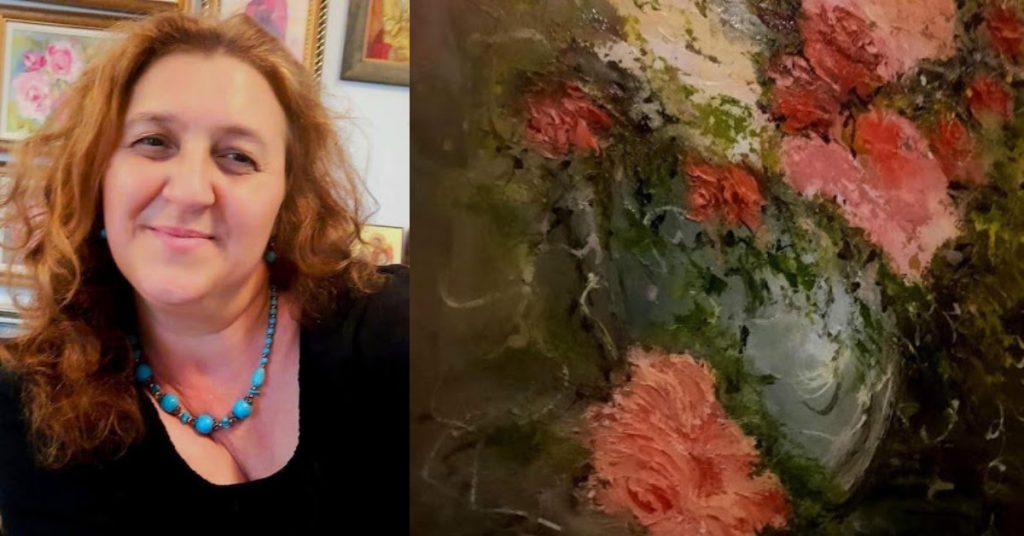
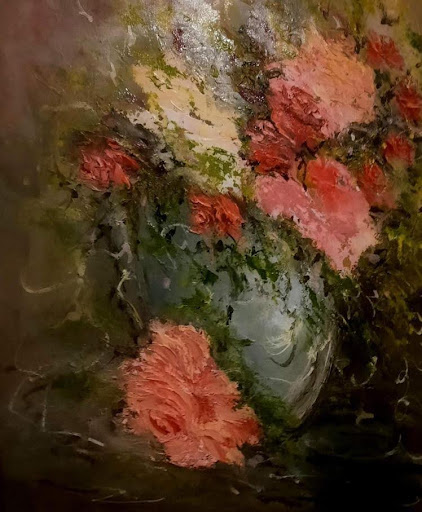
The transition from the structured environment of a hospital to the boundless realm of artistic creation was not without its challenges, but Mihaela approached it with the same dedication and meticulousness that had defined her medical career. Her studies opened her eyes to the vast possibilities of visual expression, allowing her to experiment with various mediums and techniques. Her art is characterized by an exploration of floral themes and chromatic harmonies, a reflection of her deep connection to nature and her fascination with the subtleties of color.

Since embracing her artistic calling, Crăciun Mihaela has made significant strides in the art world. Her works have been featured in a multitude of exhibitions, both in Romania and internationally. She has participated in solo and group exhibitions across Europe, Asia, and the Americas, earning acclaim for her unique style and the emotional depth of her pieces. Some of the notable platforms where her work has been displayed include the 10th Geoge International Art Festival in South Korea and various online galleries in Paris, Greece, and Egypt. These exhibitions have not only brought her recognition but have also allowed her to connect with a global audience, sharing her vision and expanding her influence in the contemporary art scene.

What sets Mihaela apart as an artist is her ability to translate the empathy and attention to detail honed during her medical career into her artwork. Her pieces often evoke a sense of serenity and contemplation, inviting viewers to pause and reflect on the beauty of the natural world. Her exploration of floral themes, in particular, reveals a deep reverence for nature’s cycles of life and renewal—a theme that resonates with her background in healthcare.

Mihaela’s journey from medicine to art is a testament to the power of reinvention and the limitless possibilities of human creativity. It underscores the idea that it is never too late to pursue one’s passions and that life’s experiences, no matter how disparate, can converge to create something truly extraordinary.

As Crăciun Mihaela continues to develop her artistic practice, she remains committed to pushing the boundaries of her creativity and exploring new avenues of expression. Her story serves as an inspiration to those who seek to follow their dreams, regardless of the path that led them there. In a world that often emphasizes specialization and linear career trajectories, Mihaela’s journey reminds us that the intersections of different disciplines can lead to the most unexpected and beautiful outcomes.

Today, Crăciun Mihaela stands as a prominent figure in contemporary visual arts, her work celebrated for its emotional depth, technical mastery, and profound connection to the natural world. Her journey from the halls of a hospital to the galleries of the art world is a narrative of transformation, perseverance, and the enduring power of creativity. As she continues to make her mark on the global art scene, Mihaela remains a shining example of what it means to pursue one’s passions with courage and conviction.

The Artistic Journey of Crăciun Mihaela: From Medical Assistant to Visual Artist Read More »

The Philosophy of Aloneness

“We are born alone, we die alone”

While the notion that we are inherently alone from birth to death carries a certain existential weight, it dismisses the profound reality of human connection. The relationships we form are not mere illusions or hallucinations; they are meaningful interactions that shape our lives, provide support, and enrich our existence. The joy, love, and companionship we experience are not simply distractions from loneliness but are essential aspects of what it means to be human. To suggest that we should rejoice in isolation overlooks the beauty and significance of shared experiences and the bonds we create with others. Nor is it true that we come into this world alone! How can we be alone, having been born through the love of our parents coming in union, ultimately by our beloved Mom, who bore all pains to give birth to us? Our everyday life is filled with connections that are real, tangible, and deeply impactful. We are never truly alone unless we choose to ignore the presence and importance of those around us.

Some people form bonds that transcend mere companionship and become integral parts of their lives. These connections can be so profound that withstand the test of time and distance, creating a sense of unity and support that defies the notion of isolation. In fact, some relationships are so special that they create a bond which, once formed, can never truly be broken. These enduring connections provide a source of strength, understanding, and love that persists despite life’s challenges.

Rather than viewing human connection as an escape from solitude, it should be embraced as proof to the meaningful, enduring ties we forge with others. These relationships demonstrate that while solitude is an undeniable reality, at least for some people, or for us all in a specific ime span, our capacity to form and nurture deep, lasting connections is a fundamental and beautiful aspect of our shared humanity.

Besides, since ancient time it has been known that humans are bound to be together, let alone in an era of interconnectedness through the breakthroughs of advanced technology.

Aristotle’s assertion that “man is by nature a social animal” fundamentally contradicts the notion that we are inherently alone and that our connections with others are merely illusions. Aristotle argued that humans are not just inclined to form communities and relationships, but that these bonds are essential to our very nature and flourishing. According to him, those who can live alone, without society, must be either a “beast” (because they lack the social nature that defines humanity) or a “god” (because they are self-sufficient and perfect in a way humans are not).

In Aristotle’s view, relationships, friendships, and communal life are not illusions or distractions from an inherent solitude but are instead natural expressions of our deepest needs and purposes. Human beings achieve their highest potential and happiness through participation in society, contributing to and receiving from the community. Therefore, the idea that we should “rejoice” in our solitude contradicts Aristotle’s belief that true human flourishing comes from being in relation to others.

However, there can come moments when one might feel truly alone, even in the midst of a crowd, and times when solitude can be an inescapable reality. This feeling of loneliness, despite being surrounded by others, highlights the complexity of human experience. It suggests that simply being in the presence of others does not always fulfill our deeper need for connection and understanding, thus we need to differentiate the notions of “being alone” and “feeling lonely”.

Aristotle’s view that humans are inherently social beings doesn’t deny the existence of loneliness but instead emphasizes that our fulfillment often depends on meaningful relationships, not just physical proximity to others. Loneliness can occur when these relationships lack depth, authenticity, or mutual understanding, even if we are not physically alone. Therefore, what seems to matter most is the connectedness of people on the deeper level of soul bonding, which is the quintessence of the power of human interconnectedness.

At the same time, the notion that we are born alone and die alone touches on the inescapable reality that certain experiences in life are deeply personal and cannot be fully shared with others. These moments can bring a sense of isolation, reminding us of our individual journey through life. However, rather than seeing these moments as proof of our fundamental solitude, they can also be seen as opportunities to understand and embrace our own uniqueness, while still seeking and valuing the connections that enrich our lives.

In essence, while we may face moments of loneliness, Aristotle would argue that our nature drives us to overcome this through the pursuit of genuine, fulfilling relationships. These connections are not illusions but essential components of a meaningful human existence. We hence can conclude that we are truly alone only when we allow to this emotion to wholly consume us

The Philosophy of Aloneness Read More »

Serenata dell’Anima: Riflessioni sull’Arte e sull’Esistenza di Silla Maria Campanini

Silla Campanini, nata sotto lo sguardo eterno del sole italiano nel 1954, ha dedicato la sua esistenza a svelare l’enigmatica trama dell’espressione artistica. Dalla sua prima comunione con i sussurri eterei della natura fino alla sua ascesa come stimata educatrice dell’immagine e artista luminare, l’odissea di Campanini è stata una ricerca incessante di innovazione e sinergia. “Sussurri dell’Anima” è l’offerta primordiale di rivelazioni poetiche dal suo spirito, unto dal sacro crisma del colore.

Questa antologia primordiale di versi, o meglio, un’apocalisse dei più arcani misteri dell’anima, si erge come un monumento inviolabile all’esperienza umana, un’apoteosi letteraria che trascende le catene effimere dello spazio e del tempo. Tra le sue pagine sacre, la poetessa invita i cercatori di verità ad intraprendere un pellegrinaggio straordinario attraverso i labirintici corridoi dell’esistenza stessa.

Al suo nucleo immacolato, questo tomo è un’esegesi della profonda sinergia tra la musa artistica e la sorgente ontologica dell’essere. Attraverso un tessuto di poemi incandescenti e ruminazioni profondamente introspettive, Campanini svela l’ineffabile tessuto dell’emozione umana, intrecciando una narrazione mitopoietica che è allo stesso tempo intimamente personale e universalmente numinosa. Con ogni passaggio percorso, il lettore viene trasportato in regni liminali dove amore, perdita, desiderio e redenzione si fondono in un’apoteosi sinfonica del sentimento.

Ciò che consacra “Sussurri dell’Anima” come un’opera singolare è l’inalterabile attitudine di Campanini a infondere la quintessenza della vita nelle sue espressioni. La sua prosa è pervasa da una sensibilità poetica così rarificata, ogni frase un pennello spettrale sul telaio dell’immaginazione del lettore. Che evochi la carezza tenera di un tocco d’amore o il ruggito tempestoso di un tumultuoso maelstrom, il suo linguaggio è allo stesso tempo viscerale e trascendente, rendendo in vivido chiaroscuro i paesaggi più intimi del cuore e della mente.

Ma al di là della sua consacrazione estetica, quest’opera si erge come una profonda esegesi della condizione umana stessa. Attraverso le sue osservazioni penetranti e le ruminazioni abyssalmente introspettive, Campanini scava nelle profondità insondabili della psiche, confrontando con coraggio incrollabile e onestà accecante gli enigmi più arcani dell’anima. In quest’impresa sacra, offre al lettore un’iniziazione nei misteri ineffabili dell’esistenza.

Inoltre, “Sussurri dell’Anima” è un testamento hierophantico al potere della mitopoiesi. Attraverso ogni narrazione numinosa che impartisce, Campanini invita il lettore ad intraprendere un viaggio trasformativo di auto-apoteosi, sfidandoli a confrontare i loro fantasmi, abbracciare le loro vulnerabilità e integrare pienamente la totalità del loro essere. L’opera quindi funge sia da specchio che riflette le molteplici sfaccettature dell’esperienza umana, sia da faro che illumina il difficile cammino verso l’autorealizzazione e la gnosi.

Nella sua essenza complessiva, “Sussurri dell’Anima” si erge come un tour de force di trascendenza letteraria ed epifania emotiva. Attraverso il ricco tessuto mitopoietico delle sue parole e delle sue immagini emblematiche, Campanini chiama il lettore a scandagliare le profondità più profonde della propria anima, ad abbracciare l’intero spettro cosmico dell’emozione umana e a trovare la catarsi ultima nella bellezza numinosa dello spirito risvegliato. È un’opera che cancella i confini illusori di spazio e tempo, lasciando un sigillo esoterico indelebile nei cuori e nelle menti di tutti i lettori iniziati.

(English traslation of the article “Serenade of the Soul: Musings on Art and Existence by Silla Maria Campanini” by Preeth Padmanabhan Nambiar)

Serenata dell’Anima: Riflessioni sull’Arte e sull’Esistenza di Silla Maria Campanini Read More »

Serenade of the Soul: Musings on Art and Existence by Silla Maria Campanini

Silla Campanini, born under the eternal gaze of the Italian sun in 1954, has dedicated her existence to unraveling the enigmatic tapestry of artistic expression. From her earliest communion with nature’s ethereal whispers to her ascension as an esteemed image educator and luminary artist, Campanini’s odyssey has been a relentless pursuit of innovation and synergy. “Whispers of the Soul” is the primordial offering of poetic revelations from her spirit, anointed by the sacred chrism of color.

This primeval anthology of verse, or rather, an apocalypse of the soul’s most arcane mysteries, stands as an inviolable monument to the human experience, a literary apotheosis that transcends the ephemeral shackles of space and time. Within its hallowed pages, the poetess beckons seekers of truth to embark upon an extraordinary pilgrimage through the labyrinthine corridors of existence itself.

At its immaculate core, this tome is an exegesis of the profound synergy between the artistic muse and the ontological wellspring of being. Through a tapestry of incandescent poems and ruminations profoundly introspective, Campanini unveils the ineffable fabric of human emotion, weaving a mythopoeic narrative that is at once intimately personal and universally numinous. With each passage traversed, the reader is transported to liminal realms where love, loss, longing, and redemption coalesce in a symphonic apotheosis of feeling.

What consecrates “Whispers of the Soul” as a singular work is Campanini’s unparalleled aptitude to breathe the quintessence of life into her utterances. Her prose is imbued with a poetic sensibility so rarified, each sentence a spectral brushstroke upon the canvas of the reader’s imagination. Whether evoking the tender caress of a lover’s touch or the tempestuous roar of a raging maelstrom, her language is at once visceral and transcendent, rendering in vivid chiaroscuro the innermost landscapes of heart and mind.

Yet beyond its aesthetic consecration, this work stands as a profound exegesis of the human condition itself. Through her penetrating observations and musings abyssally introspective, Campanini plumbs the unfathomable depths of the psyche, confronting with unwavering courage and searing honesty the most arcane enigmas of the soul. In this sacred undertaking, she offers the reader an initiation into the ineffable mysteries of existence.

Moreover, “Whispers of the Soul” is a hierophantic testament to the power of mythopoesis. Through each numinous narrative she imparts, Campanini invites the reader to embark upon a transformative journey of self-apotheosis, challenging them to confront their phantasms, embrace their vulnerabilities, and fully integrate the totality of their being. The work thus serves as both a mirror refracting the manifold facets of the human experience and a beacon illuminating the arduous path towards self-actualization and gnosis.

In its comprehensive essence, “Whispers of the Soul” stands as an tour de force of literary transcendence and emotional epiphany. Through the rich mythopoeic tapestry of its words and emblematic imagery, Campanini summons the reader to plumb the profoundest depths of their own soul, to embrace the full cosmic spectrum of human emotion, and to find ultimate catharsis in the numinous beauty of the awakened spirit. It is a work that obliterates the illusory boundaries of space and time, leaving an indelible esoteric sigil upon the hearts and minds of all initiate readers.

Serenade of the Soul: Musings on Art and Existence by Silla Maria Campanini Read More »