Writers International Edition

weadmin

THE HAUNTED MIND

What a singular moment is the first one, when you have hardly begun to recollect yourself, after starting from midnight slumber! By unclosing your eyes so suddenly you seem to have surprised the personages of your dream in full convocation round your bed, and catch one broad glance at them before they can flit into obscurity. Or, to vary the metaphor, you find yourself for a single instant wide awake in that realm of illusions whither sleep has been the passport, and behold its ghostly inhabitants and wondrous scenery with a perception of their strangeness such as you never attain while the dream is undisturbed. The distant sound of a church-clock is borne faintly on the wind. You question with yourself, half seriously, whether it has stolen to your waking ear from some gray tower that stood within the precincts of your dream. While yet in suspense another clock flings its heavy clang over the slumbering town with so full and distinct a sound, and such a long murmur in the neighboring air, that you are certain it must proceed from the steeple at the nearest corner; You count the strokes—one, two; and there they cease with a booming sound like the gathering of a third stroke within the bell.

If you could choose an hour of wakefulness out of the whole night, it would be this. Since your sober bedtime, at eleven, you have had rest enough to take off the pressure of yesterday’s fatigue, while before you, till the sun comes from “Far Cathay” to brighten your window, there is almost the space of a summer night—one hour to be spent in thought with the mind’s eye half shut, and two in pleasant dreams, and two in that strangest of enjoyments the forgetfulness alike of joy and woe. The moment of rising belongs to another period of time, and appears so distant that the plunge out of a warm bed into the frosty air cannot yet be anticipated with dismay. Yesterday has already vanished among the shadows of the past; to-morrow has not yet emerged from the future. You have found an intermediate space where the business of life does not intrude, where the passing moment lingers and becomes truly the present; a spot where Father Time, when he thinks nobody is watching him, sits down by the wayside to take breath. Oh that he would fall asleep and let mortals live on without growing older!

Hitherto you have lain perfectly still, because the slightest motion would dissipate the fragments of your slumber. Now, being irrevocably awake, you peep through the half-drawn window-curtain, and observe that the glass is ornamented with fanciful devices in frost-work, and that each pane presents something like a frozen dream. There will be time enough to trace out the analogy while waiting the summons to breakfast. Seen through the clear portion of the glass where the silvery mountain-peaks of the frost-scenery do not ascend, the most conspicuous object is the steeple, the white spire of which directs you to the wintry lustre of the firmament. You may almost distinguish the figures on the clock that has just told the hour. Such a frosty sky and the snow-covered roofs and the long vista of the frozen street, all white, and the distant water hardened into rock, might make you shiver even under four blankets and a woollen comforter. Yet look at that one glorious star! Its beams are distinguishable from all the rest, and actually cast the shadow of the casement on the bed with a radiance of deeper hue than moonlight, though not so accurate an outline.

You sink down and muffle your head in the clothes, shivering all the while, but less from bodily chill than the bare idea of a polar atmosphere. It is too cold even for the thoughts to venture abroad. You speculate on the luxury of wearing out a whole existence in bed like an oyster in its shell, content with the sluggish ecstasy of inaction, and drowsily conscious of nothing but delicious warmth such as you now feel again. Ah! that idea has brought a hideous one in its train. You think how the dead are lying in their cold shrouds and narrow coffins through the drear winter of the grave, and cannot persuade your fancy that they neither shrink nor shiver when the snow is drifting over their little hillocks and the bitter blast howls against the door of the tomb. That gloomy thought will collect a gloomy multitude and throw its complexion over your wakeful hour.

In the depths of every heart there is a tomb and a dungeon, though the lights, the music and revelry, above may cause us to forget their existence and the buried ones or prisoners whom they hide. But sometimes, and oftenest at midnight, those dark receptacles are flung wide open. In an hour like this, when the mind has a passive sensibility, but no active strength—when the imagination is a mirror imparting vividness to all ideas without the power of selecting or controlling them—then pray that your griefs may slumber and the brotherhood of remorse not break their chain. It is too late. A funeral train comes gliding by your bed in which passion and feeling assume bodily shape and things of the mind become dim spectres to the eye. There is your earliest sorrow, a pale young mourner wearing a sister’s likeness to first love, sadly beautiful, with a hallowed sweetness in her melancholy features and grace in the flow of her sable robe. Next appears a shade of ruined loveliness with dust among her golden hair and her bright garments all faded and defaced, stealing from your glance with drooping head, as fearful of reproach: she was your fondest hope, but a delusive one; so call her Disappointment now. A sterner form succeeds, with a brow of wrinkles, a look and gesture of iron authority; there is no name for him unless it be Fatality—an emblem of the evil influence that rules your fortunes, a demon to whom you subjected yourself by some error at the outset of life, and were bound his slave for ever by once obeying him. See those fiendish lineaments graven on the darkness, the writhed lip of scorn, the mockery of that living eye, the pointed finger touching the sore place in your heart! Do you remember any act of enormous folly at which you would blush even in the remotest cavern of the earth? Then recognize your shame.

Pass, wretched band! Well for the wakeful one if, riotously miserable, a fiercer tribe do not surround him—the devils of a guilty heart that holds its hell within itself. What if Remorse should assume the features of an injured friend? What if the fiend should come in woman’s garments with a pale beauty amid sin and desolation, and lie down by your side? What if he should stand at your bed’s foot in the likeness of a corpse with a bloody stain upon the shroud? Sufficient without such guilt is this nightmare of the soul, this heavy, heavy sinking of the spirits, this wintry gloom about the heart, this indistinct horror of the mind blending itself with the darkness of the chamber.

By a desperate effort you start upright, breaking from a sort of conscious sleep and gazing wildly round the bed, as if the fiends were anywhere but in your haunted mind. At the same moment the slumbering embers on the hearth send forth a gleam which palely illuminates the whole outer room and flickers through the door of the bedchamber, but cannot quite dispel its obscurity. Your eye searches for whatever may remind you of the living world. With eager minuteness you take note of the table near the fireplace, the book with an ivory knife between its leaves, the unfolded letter, the hat and the fallen glove. Soon the flame vanishes, and with it the whole scene is gone, though its image remains an instant in your mind’s eye when darkness has swallowed the reality. Throughout the chamber there is the same obscurity as before, but not the same gloom within your breast.

As your head falls back upon the pillow you think—in a whisper be it spoken—how pleasant in these night solitudes would be the rise and fall of a softer breathing than your own, the slight pressure of a tenderer bosom, the quiet throb of a purer heart, imparting its peacefulness to your troubled one, as if the fond sleeper were involving you in her dream. Her influence is over you, though she have no existence but in that momentary image. You sink down in a flowery spot on the borders of sleep and wakefulness, while your thoughts rise before you in pictures, all disconnected, yet all assimilated by a pervading gladsomeness and beauty. The wheeling of gorgeous squadrons that glitter in the sun is succeeded by the merriment of children round the door of a schoolhouse beneath the glimmering shadow of old trees at the corner of a rustic lane. You stand in the sunny rain of a summer shower, and wander among the sunny trees of an autumnal wood, and look upward at the brightest of all rainbows overarching the unbroken sheet of snow on the American side of Niagara. Your mind struggles pleasantly between the dancing radiance round the hearth of a young man and his recent bride and the twittering flight of birds in spring about their new-made nest. You feel the merry bounding of a ship before the breeze, and watch the tuneful feet of rosy girls as they twine their last and merriest dance in a splendid ball-room, and find yourself in the brilliant circle of a crowded theatre as the curtain falls over a light and airy scene.

With an involuntary start you seize hold on consciousness, and prove yourself but half awake by running a doubtful parallel between human life and the hour which has now elapsed. In both you emerge from mystery, pass through a vicissitude that you can but imperfectly control, and are borne onward to another mystery. Now comes the peal of the distant clock with fainter and fainter strokes as you plunge farther into the wilderness of sleep. It is the knell of a temporary death. Your spirit has departed, and strays like a free citizen among the people of a shadowy world, beholding strange sights, yet without wonder or dismay. So calm, perhaps, will be the final change—so undisturbed, as if among familiar things, the entrance of the soul to its eternal home.

THE HAUNTED MIND Read More »

ONE SUMMER NIGHT

The fact that Henry Armstrong was buried did not seem to him to prove that he was dead: he had always been a hard man to convince. That he really was buried, the testimony of his senses compelled him to admit. His posture — flat upon his back, with his hands crossed upon his stomach and tied with something that he easily broke without profitably altering the situation — the strict confinement of his entire person, the black darkness and profound silence, made a body of evidence impossible to controvert and he accepted it without cavil.

But dead — no; he was only very, very ill. He had, withal, the invalid’s apathy and did not greatly concern himself about the uncommon fate that had been allotted to him. No philosopher was he — just a plain, commonplace person gifted, for the time being, with a pathological indifference: the organ that he feared consequences with was torpid. So, with no particular apprehension for his immediate future, he fell asleep and all was peace with Henry Armstrong.

But something was going on overhead. It was a dark summer night, shot through with infrequent shimmers of lightning silently firing a cloud lying low in the west and portending a storm. These brief, stammering illuminations brought out with ghastly distinctness the monuments and headstones of the cemetery and seemed to set them dancing. It was not a night in which any credible witness was likely to be straying about a cemetery, so the three men who were there, digging into the grave of Henry Armstrong, felt reasonably secure.

Two of them were young students from a medical college a few miles away; the third was a gigantic negro known as Jess. For many years Jess had been employed about the cemetery as a man-of-all-work and it was his favourite pleasantry that he knew ‘every soul in the place.’ From the nature of what he was now doing it was inferable that the place was not so populous as its register may have shown it to be.

Outside the wall, at the part of the grounds farthest from the public road, were a horse and a light wagon, waiting.

The work of excavation was not difficult: the earth with which the grave had been loosely filled a few hours before offered little resistance and was soon thrown out. Removal of the casket from its box was less easy, but it was taken out, for it was a perquisite of Jess, who carefully unscrewed the cover and laid it aside, exposing the body in black trousers and white shirt. At that instant the air sprang to flame, a cracking shock of thunder shook the stunned world and Henry Armstrong tranquilly sat up. With inarticulate cries the men fled in terror, each in a different direction. For nothing on earth could two of them have been persuaded to return. But Jess was of another breed.

In the grey of the morning the two students, pallid and haggard from anxiety and with the terror of their adventure still beating tumultuously in their blood, met at the medical college.

‘You saw it?’ cried one.

‘God! yes — what are we to do?’

They went around to the rear of the building, where they saw a horse, attached to a light wagon, hitched to a gatepost near the door of the dissecting-room. Mechanically they entered the room. On a bench in the obscurity sat the negro Jess. He rose, grinning, all eyes and teeth.

‘I’m waiting for my pay,’ he said.

Stretched naked on a long table lay the body of Henry Armstrong, the head defiled with blood and clay from a blow with a spade.

ONE SUMMER NIGHT Read More »

THE TERRIBLE OLD MAN

It was the design of Angelo Ricci and Joe Czanek and Manuel Silva to call on the Terrible Old Man. This old man dwells all alone in a very ancient house on Water Street near the sea, and is reputed to be both exceedingly rich and exceedingly feeble; which forms a situation very attractive to men of the profession of Messrs. Ricci, Czanek, and Silva, for that profession was nothing less dignified than robbery.

The inhabitants of Kingsport say and think many things about the Terrible Old Man which generally keep him safe from the attention of gentlemen like Mr. Ricci and his colleagues, despite the almost certain fact that he hides a fortune of indefinite magnitude somewhere about his musty and venerable abode. He is, in truth, a very strange person, believed to have been a captain of East India clipper ships in his day; so old that no one can remember when he was young, and so taciturn that few know his real name. Among the gnarled trees in the front yard of his aged and neglected place he maintains a strange collection of large stones, oddly grouped and painted so that they resemble the idols in some obscure Eastern temple. This collection frightens away most of the small boys who love to taunt the Terrible Old Man about his long white hair and beard, or to break the small-paned windows of his dwelling with wicked missiles; but there are other things which frighten the older and more curious folk who sometimes steal up to the house to peer in through the dusty panes. These folk say that on a table in a bare room on the ground floor are many peculiar bottles, in each a small piece of lead suspended pendulum-wise from a string. And they say that the Terrible Old Man talks to these bottles, addressing them by such names as Jack, Scar-Face, Long Tom, Spanish Joe, Peters, and Mate Ellis, and that whenever he speaks to a bottle the little lead pendulum within makes certain definite vibrations as if in answer.

Those who have watched the tall, lean, Terrible Old Man in these peculiar conversations, do not watch him again. But Angelo Ricci and Joe Czanek and Manuel Silva were not of Kingsport blood; they were of that new and heterogeneous alien stock which lies outside the charmed circle of New England life and traditions, and they saw in the Terrible Old Man merely a tottering, almost helpless grey-beard, who could not walk without the aid of his knotted cane, and whose thin, weak hands shook pitifully. They were really quite sorry in their way for the lonely, unpopular old fellow, whom everybody shunned, and at whom all the dogs barked singularly. But business is business, and to a robber whose soul is in his profession, there is a lure and a challenge about a very old and very feeble man who has no account at the bank, and who pays for his few necessities at the village store with Spanish gold and silver minted two centuries ago.

Messrs. Ricci, Czanek, and Silva selected the night of April 11th for their call. Mr. Ricci and Mr. Silva were to interview the poor old gentleman, whilst Mr. Czanek waited for them and their presumable metallic burden with a covered motor-car in Ship Street, by the gate in the tall rear wall of their hosts grounds. Desire to avoid needless explanations in case of unexpected police intrusions prompted these plans for a quiet and unostentatious departure.

As prearranged, the three adventurers started out separately in order to prevent any evil-minded suspicions afterward. Messrs. Ricci and Silva met in Water Street by the old man’s front gate, and although they did not like the way the moon shone down upon the painted stones through the budding branches of the gnarled trees, they had more important things to think about than mere idle superstition. They feared it might be unpleasant work making the Terrible Old Man loquacious concerning his hoarded gold and silver, for aged sea-captains are notably stubborn and perverse. Still, he was very old and very feeble, and there were two visitors. Messrs. Ricci and Silva were experienced in the art of making unwilling persons voluble, and the screams of a weak and exceptionally venerable man can be easily muffled. So they moved up to the one lighted window and heard the Terrible Old Man talking childishly to his bottles with pendulums. Then they donned masks and knocked politely at the weather-stained oaken door.

Waiting seemed very long to Mr. Czanek as he fidgeted restlessly in the covered motor-car by the Terrible Old Man’s back gate in Ship Street. He was more than ordinarily tender-hearted, and he did not like the hideous screams he had heard in the ancient house just after the hour appointed for the deed. Had he not told his colleagues to be as gentle as possible with the pathetic old sea-captain? Very nervously he watched that narrow oaken gate in the high and ivy-clad stone wall. Frequently he consulted his watch, and wondered at the delay. Had the old man died before revealing where his treasure was hidden, and had a thorough search become necessary? Mr. Czanek did not like to wait so long in the dark in such a place. Then he sensed a soft tread or tapping on the walk inside the gate, heard a gentle fumbling at the rusty latch, and saw the narrow, heavy door swing inward. And in the pallid glow of the single dim street-lamp he strained his eyes to see what his colleagues had brought out of that sinister house which loomed so close behind. But when he looked, he did not see what he had expected; for his colleagues were not there at all, but only the Terrible Old Man leaning quietly on his knotted cane and smiling hideously. Mr. Czanek had never before noticed the colour of that mans eyes; now he saw that they were yellow.

Little things make considerable excitement in little towns, which is the reason that Kingsport people talked all that spring and summer about the three unidentifiable bodies, horribly slashed as with many cutlasses, and horribly mangled as by the tread of many cruel boot-heels, which the tide washed in. And some people even spoke of things as trivial as the deserted motor-car found in Ship Street, or certain especially inhuman cries, probably of a stray animal or migratory bird, heard in the night by wakeful citizens. But in this idle village gossip the Terrible Old Man took no interest at all. He was by nature reserved, and when one is aged and feeble, one’s reserve is doubly strong. Besides, so ancient a sea-captain must have witnessed scores of things much more stirring in the far-off days of his unremembered youth.

THE TERRIBLE OLD MAN Read More »

THE STORY OF AN HOUR

Knowing that Mrs. Mallard was afflicted with a heart trouble, great care was taken to break to her as gently as possible the news of her husband’s death.

It was her sister Josephine who told her, in broken sentences; veiled hints that revealed in half concealing. Her husband’s friend Richards was there, too, near her. It was he who had been in the newspaper office when intelligence of the railroad disaster was received, with Brently Mallard’s name leading the list of “killed.” He had only taken the time to assure himself of its truth by a second telegram, and had hastened to forestall any less careful, less tender friend in bearing the sad message.

She did not hear the story as many women have heard the same, with a paralyzed inability to accept its significance. She wept at once, with sudden, wild abandonment, in her sister’s arms. When the storm of grief had spent itself she went away to her room alone. She would have no one follow her.

There stood, facing the open window, a comfortable, roomy armchair. Into this she sank, pressed down by a physical exhaustion that haunted her body and seemed to reach into her soul.

She could see in the open square before her house the tops of trees that were all aquiver with the new spring life. The delicious breath of rain was in the air. In the street below a peddler was crying his wares. The notes of a distant song which someone was singing reached her faintly, and countless sparrows were twittering in the eaves.

There were patches of blue sky showing here and there through the clouds that had met and piled one above the other in the west facing her window.

She sat with her head thrown back upon the cushion of the chair, quite motionless, except when a sob came up into her throat and shook her, as a child who has cried itself to sleep continues to sob in its dreams.

She was young, with a fair, calm face, whose lines bespoke repression and even a certain strength. But now there was a dull stare in her eyes, whose gaze was fixed away off yonder on one of those patches of blue sky. It was not a glance of reflection, but rather indicated a suspension of intelligent thought.

There was something coming to her and she was waiting for it, fearfully. What was it? She did not know; it was too subtle and elusive to name. But she felt it, creeping out of the sky, reaching toward her through the sounds, the scents, the color that filled the air.

Now her bosom rose and fell tumultuously. She was beginning to recognize this thing that was approaching to possess her, and she was striving to beat it back with her will–as powerless as her two white slender hands would have been. When she abandoned herself a little whispered word escaped her slightly parted lips. She said it over and over under the breath: “free, free, free!” The vacant stare and the look of terror that had followed it went from her eyes. They stayed keen and bright. Her pulses beat fast, and the coursing blood warmed and relaxed every inch of her body.

She did not stop to ask if it were or were not a monstrous joy that held her. A clear and exalted perception enabled her to dismiss the suggestion as trivial. She knew that she would weep again when she saw the kind, tender hands folded in death; the face that had never looked save with love upon her, fixed and gray and dead. But she saw beyond that bitter moment a long procession of years to come that would belong to her absolutely. And she opened and spread her arms out to them in welcome.

There would be no one to live for during those coming years; she would live for herself. There would be no powerful will bending hers in that blind persistence with which men and women believe they have a right to impose a private will upon a fellow-creature. A kind intention or a cruel intention made the act seem no less a crime as she looked upon it in that brief moment of illumination.

And yet she had loved him–sometimes. Often she had not. What did it matter! What could love, the unsolved mystery, count for in the face of this possession of self-assertion which she suddenly recognized as the strongest impulse of her being!

“Free! Body and soul free!” she kept whispering.

Josephine was kneeling before the closed door with her lips to the keyhole, imploring for admission. “Louise, open the door! I beg; open the door–you will make yourself ill. What are you doing, Louise? For heaven’s sake open the door.”

“Go away. I am not making myself ill.” No; she was drinking in a very elixir of life through that open window.

Her fancy was running riot along those days ahead of her. Spring days, and summer days, and all sorts of days that would be her own. She breathed a quick prayer that life might be long. It was only yesterday she had thought with a shudder that life might be long.

She arose at length and opened the door to her sister’s importunities. There was a feverish triumph in her eyes, and she carried herself unwittingly like a goddess of Victory. She clasped her sister’s waist, and together they descended the stairs. Richards stood waiting for them at the bottom.

Someone was opening the front door with a latchkey. It was Brently Mallard who entered, a little travel-stained, composedly carrying his grip-sack and umbrella. He had been far from the scene of the accident, and did not even know there had been one. He stood amazed at Josephine’s piercing cry; at Richards’ quick motion to screen him from the view of his wife.

When the doctors came they said she had died of heart disease–of the joy that kills.

THE STORY OF AN HOUR Read More »

THE TALE OF PETER RABBIT

ONCE upon a time there were four little Rabbits, and their names were— Flopsy, Mopsy, Cotton-tail, and Peter.

They lived with their Mother in a sand-bank, underneath the root of a very big fir tree.

“NOW, my dears,” said old Mrs. Rabbit one morning, “you may go into the fields or down the lane, but don’t go into Mr. McGregor’s garden: your Father had an accident there; he was put in a pie by Mrs. McGregor.”

“NOW run along, and don’t get into mischief. I am going out.”

THEN old Mrs. Rabbit took a basket and her umbrella, to the baker’s. She bought a loaf of brown bread and five currant buns.

FLOPSY, Mopsy, and Cottontail, who were good little bunnies, went down the lane to gather blackberries;

Peter Rabbit gateBUT Peter, who was very naughty, ran straight away to Mr. McGregor’s garden and squeezed under the gate!

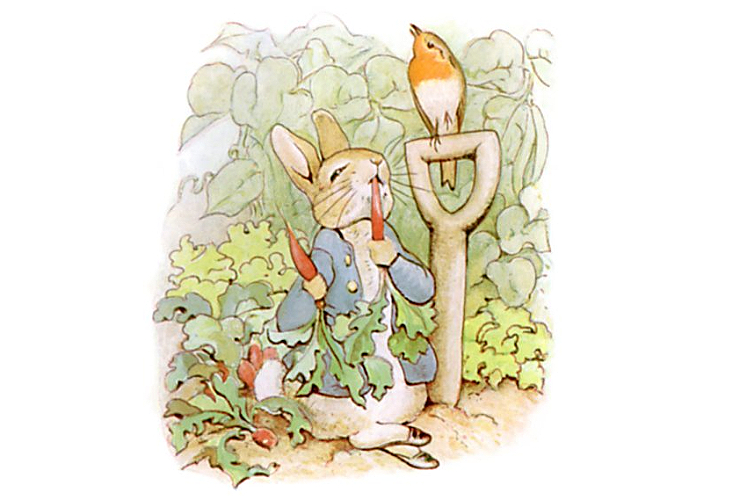
FIRST he ate some lettuces and some French beans; and then he ate some radishes;

AND then, feeling rather sick, he went to look for some parsley.

BUT round the end of a cucumber frame, whom should he meet but Mr. McGregor!

MR. McGREGOR was on his hands and knees planting out young cabbages, but he jumped up and ran after Peter, waving a rake and calling out, “Stop thief!”

PETER was most dreadfully frightened; he rushed all over the garden, for he had forgotten the way back to the gate.

He lost one of his shoes among the cabbages, and the other shoe amongst the potatoes.

AFTER losing them, he ran on four legs and went faster, so that I think he might have got away altogether if he had not unfortunately run into a gooseberry net, and got caught by the large buttons on his jacket. It was a blue jacket with brass buttons, quite new.

Peter Rabbit gooseberry nextPETER gave himself up for lost, and shed big tears; but his sobs were overheard by some friendly sparrows, who flew to him in great excitement, and implored him to exert himself.

MR. McGREGOR came up with a sieve, which he intended to pop upon the top of Peter; but Peter wriggled out just in time, leaving his jacket behind him.

AND rushed into the toolshed, and jumped into a can. It would have been a beautiful thing to hide in, if it had not had so much water in it.

MR. McGREGOR was quite sure that Peter was somewhere in the toolshed, perhaps hidden underneath a flower-pot. He began to turn them over carefully, looking under each.

Presently Peter sneezed— “Kertyschoo!” Mr. McGregor was after him in no time,

AND tried to put his foot upon Peter, who jumped out of a window, upsetting three plants. The window was too small for Mr. McGregor, and he was tired of running after Peter. He went back to his work.

PETER sat down to rest; he was out of breath and trembling with fright, and he had not the least idea which way to go. Also he was very damp with sitting in that can.

After a time he began to wander about, going lippity— lippity—not very fast, and looking all around.

HE found a door in a wall; but it was locked, and there was no room for a fat little rabbit to squeeze underneath.

An old mouse was running in and out over the stone doorstep, carrying peas and beans to her family in the wood. Peter asked her the way to the gate, but she had such a large pea in her mouth that she could not answer. She only shook her head at him. Peter began to cry.

Peter Rabbit in wheelbarrowTHEN he tried to find his way straight across the garden, but he became more and more puzzled. Presently, he came to a pond where Mr. McGregor filled his water-cans. A white cat was staring at some gold-fish; she sat very, very still, but now and then the tip of her tail twitched as if it were alive. Peter thought it best to go away without speaking to her; he had heard about cats from his cousin, little Benjamin Bunny.

HE went back towards the tool-shed, but suddenly, quite close to him, he heard the noise of a hoe—scr-r-ritch, scratch, scratch, scritch. Peter scuttered underneath the bushes. But presently, as nothing happened, he came out, and climbed upon a wheelbarrow, and peeped over. The first thing he saw was Mr. McGregor hoeing onions. His back was turned towards Peter, and beyond him was the gate!

PETER got down very quietly off the wheelbarrow, and started running as fast as he could go, along a straight walk behind some black-currant bushes.

Mr. McGregor caught sight of him at the corner, but Peter did not care. He slipped underneath the gate, and was safe at last in the wood outside the garden.

Peter Rabbit hung coat shoesMR. McGREGOR hung up the little jacket and the shoes for a scare-crow to frighten the blackbirds.

PETER never stopped running or looked behind him till he got home to the big fir-tree.

He was so tired that he flopped down upon the nice soft sand on the floor of the rabbit-hole, and shut his eyes. His mother was busy cooking; she wondered what he had done with his clothes. It was the second little jacket and pair of shoes that Peter had lost in a fortnight!

I AM sorry to say that Peter was not very well during the evening.

His mother put him to bed, and made some camomile tea; and she gave a dose of it to Peter!

“One table-spoonful to be taken at bed-time.”

BUT Flopsy, Mopsy, and Cotton-tail had bread and milk and blackberries, for supper.

Peter Rabbit siblings end

THE END

THE TALE OF PETER RABBIT Read More »

JACK AND THE BEANSTALK

Once upon a time there lived a poor widow and her son Jack. One day, Jack’s mother told him to sell their only cow. Jack went to the market and on the way he met a man who wanted to buy his cow. Jack asked, “What will you give me in return for my cow?” The man answered, “I will give you five magic beans!” Jack took the magic beans and gave the man the cow. But when he reached home, Jack’s mother was very angry. She said, “You fool! He took away your cow and gave you some beans!” She threw the beans out of the window. Jack was very sad and went to sleep without dinner.

The next day, when Jack woke up in the morning and looked out of the window, he saw that a huge beanstalk had grown from his magic beans! He climbed up the beanstalk and reached a kingdom in the sky. There lived a giant and his wife. Jack went inside the house and found the giant’s wife in the kitchen. Jack said, “Could you please give me something to eat? I am so hungry!” The kind wife gave him bread and some milk.

While he was eating, the giant came home. The giant was very big and looked very fearsome. Jack was terrified and went and hid inside. The giant cried, “Fee-fi-fo-fum, I smell the blood of an Englishman. Be he alive, or be he dead, I’ll grind his bones to make my bread!” The wife said, “There is no boy in here!” So, the giant ate his food and then went to his room. He took out his sacks of gold coins, counted them and kept them aside. Then he went to sleep. In the night, Jack crept out of his hiding place, took one sack of gold coins and climbed down the beanstalk. At home, he gave the coins to his mother. His mother was very happy and they lived well for sometime.

Jack and the Beanstalk Fee Fi Fo Fum!Climbed the beanstalk and went to the giant’s house again. Once again, Jack asked the giant’s wife for food, but while he was eating the giant returned. Jack leapt up in fright and went and hid under the bed. The giant cried, “Fee-fifo-fum, I smell the blood of an Englishman. Be he alive, or be he dead, I’ll grind his bones to make my bread!” The wife said, “There is no boy in here!” The giant ate his food and went to his room. There, he took out a hen. He shouted, “Lay!” and the hen laid a golden egg. When the giant fell asleep, Jack took the hen and climbed down the beanstalk. Jack’s mother was very happy with him.

After some days, Jack once again climbed the beanstalk and went to the giant’s castle. For the third time, Jack met the giant’s wife and asked for some food. Once again, the giant’s wife gave him bread and milk. But while Jack was eating, the giant came home. “Fee-fi-fo-fum, I smell the blood of an Englishman. Be he alive, or be he dead, I’ll grind his bones to make my bread!” cried the giant. “Don’t be silly! There is no boy in here!” said his wife.

The giant had a magical harp that could play beautiful songs. While the giant slept, Jack took the harp and was about to leave. Suddenly, the magic harp cried, “Help master! A boy is stealing me!” The giant woke up and saw Jack with the harp. Furious, he ran after Jack. But Jack was too fast for him. He ran down the beanstalk and reached home. The giant followed him down. Jack quickly ran inside his house and fetched an axe. He began to chop the beanstalk. The giant fell and died.

Jack and his mother were now very rich and they lived happily ever after.

JACK AND THE BEANSTALK Read More »

EXPLORE PERSONAL STYLE WITH HOME DECORATING TIPS FROM AN ARTIST

Decorating can be one of the most exciting times during your experience as a homeowner. Not only are you creating the essence of your home, you are also adding your very own personal touch and style.

One of the easiest ways to add unique spice to an ordinarily drab room—incorporate exceptional artwork .

“Many of my clients are simply amazed at how effective a colorful painting can be at bringing new life to a room that has become tired,” says Matthew Johnston, an artist known for his vibrant Tall Tulips paintings (talltulips.com).

However, as easy as it sounds, purchasing and hanging a painting on the center of the wall isn’t going to cut it in most cases. Johnston offers his advice to ensure your next painting purchases work with your room rather than against it:

Large High-Traffic Rooms

For family rooms, living rooms and rooms off the kitchen, Johnston recommends figurative diptych paintings to create a story within each area. Diptych paintings consists of two separate panels that hang together and work as one.

“In my figurative diptych paintings, each figure has their own physical space, yet they are a couple,” says Johnston. “Their face is cropped, and viewers can imagine themselves as being in the painting. The viewer has to look to other parts of the painting to imagine a story … each individual person can create a different story for the painting.”

Awkward Wall Spaces

For stairways, long hallways and between windows, Johnston recommends using a tall, narrow painting, like his Tall Tulips.

“They are perfect for hanging up a staircase,” says Johnston. “You can hang the tall tulips at different heights following the risers up the stairs; a great look for a difficult space.”

This style of painting also works well because they are bright and don’t require ideal lighting.

Focal Wall Areas

Spaces like the area over a fireplace will get a lot of attention from passersby. Hanging your prized piece is the perfect step for these spots.

“Many of my clients choose my large floral paintings,” says Johnston. “Oftentimes, they will hang these on a wall which faces the front door … to make an impression when first walking into the home.”

To learn more about Matthew Johnston and his work, visit www.talltulips.com.

EXPLORE PERSONAL STYLE WITH HOME DECORATING TIPS FROM AN ARTIST Read More »

STOPPING BY WOODS ON A SNOWY EVENING

Whose woods these are I think I know.
His house is in the village though;
He will not see me stopping here
To watch his woods fill up with snow.
My little horse must think it queer
To stop without a farmhouse near
Between the woods and frozen lake
The darkest evening of the year.
He gives his harness bells a shake
To ask if there is some mistake.
The only other sound’s the sweep
Of easy wind and downy flake.
The woods are lovely, dark and deep,
But I have promises to keep,
And miles to go before I sleep,
And miles to go before I sleep.

ROBERT FROST

STOPPING BY WOODS ON A SNOWY EVENING Read More »

CLASSICAL GREEK CULTURE

Philosophy and science

Building on the discoveries and knowledge of civilizations in Egypt and Mesopotamia, among others, the Ancient Greeks developed a sophisticated philosophical and scientific culture. One of the key points of Ancient Greek philosophy was the role of reason and inquiry. It emphasized logic and championed the idea of impartial, rational observation of the natural world.

The Greeks made major contributions to math and science. We owe our basic ideas about geometry and the concept of mathematical proofs to ancient Greek mathematicians such as Pythagoras, Euclid, and Archimedes. Some of the first astronomical models were developed by Ancient Greeks trying to describe planetary movement, the Earth’s axis, and the heliocentric system—a model that places the Sun at the center of the solar system. Hippocrates, another ancient Greek, is the most famous physician in antiquity. He established a medical school, wrote many medical treatises, and is— because of his systematic and empirical investigation of diseases and remedies—credited with being the founder of modern medicine. The Hippocratic oath, a medical standard for doctors, is named after him.
Greek philosophical culture is exemplified in the dialogues of Plato, who turned the questioning style of Socrates into written form. Aristotle, Plato’s student, wrote about topics as varied as biology and drama.

Art, literature, and theatre

Literature and theatre, which were very intertwined, were important in ancient Greek society. Greek theatre began in the sixth century BCE in Athens with the performance of tragedy plays at religious festivals. These, in turn, inspired the genre of Greek comedy plays.
These two types of Greek drama became hugely popular, and performances spread around the Mediterranean and influenced Hellenistic and Roman theatre. The works of playwrights like Sophocles and Aristophanes formed the foundation upon which all modern theatre is based. In fact, while it may seem like dialogue was always a part of literature, it was rare before a playwright named Aeschylus introduced the idea of characters interacting with dialogue. Other theatrical devices, like irony, were exemplified in works like Sophocles’ Oedipus the King.

In addition to written forms of theater and literature, oral traditions were important, especially in early Greek history. It wasn’t until around 670 BCE that Homer’s epic poems, The Iliad and Odyssey, were compiled into text form.

Greek art, particularly sculpture and architecture, was also incredibly influential on other societies. Greek sculpture from 800 to 300 BCE took inspiration from Egyptian and Near Eastern monumental art and, over centuries, evolved into a uniquely Greek vision of the art form.

Greek artists reached a peak of excellence which captured the human form in a way never before seen and much copied. Greek sculptors were particularly concerned with proportion, poise, and the idealized perfection of the human body; their figures in stone and bronze have become some of the most recognizable pieces of art ever produced by any civilization.

Greek architects provided some of the finest and most distinctive buildings in the entire Ancient World and some of their structures— including temples, theatres, and stadia—would become staple features of towns and cities from antiquity onwards.

In addition, the Greek concern with simplicity, proportion, perspective, and harmony in their buildings would go on to greatly influence architects in the Roman world and provide the foundation for the classical architectural orders which would dominate the western world from the Renaissance to the present day.

The legacy of Greek culture

The civilization of ancient Greece was immensely influential in many spheres: language, politics, educational systems, philosophy, science, and the arts. It had major effects on the Roman Empire which ultimately ruled it. As Horace put it, “Captive Greece took captive her fierce conqueror and instilled her arts in rustic Latium.”

Via the Roman Empire, Greek culture came to be foundational to Western culture in general. The Byzantine Empire inherited Classical Greek culture directly, without Latin intermediation, and the preservation of classical Greek learning in medieval Byzantine tradition exerted strong influence on the Slavs and later on the Islamic Golden Age and the Western European Renaissance. A modern revival of Classical Greek learning took place in the Neoclassicism movement in eighteenth- and nineteenth-century Europe and the Americas.


CLASSICAL GREEK CULTURE Read More »

CASH MANAGEMENT – A PERSISTENT NECESSITY FOR BUSINESS GROWTH

ABSTRACT

Cash is the important current asset for the operations of the business. It is the basic input needed to keep the business running on a continuous basis; it is also the ultimate output expected to be realized by selling the service or product manufactured by the company. Cash management involves managing cash efficiently, the proper usage of cash while assessing liquidity and the cash flow and investments. Cash planning protects the financial condition of the firm by developing a projected cash statement from a forecast of expected cash inflows and outflows for a given period. Cash management necessitates speeding cash inflows while slowing down cash outflows, but it may not be considered in isolation. A company’s cash flow is coupled to its operations, investment activities (such as the purchase or the sale of capital equipment), and to its financing activities (such as raising debt or equity funding or repaying such funding). The cash that a firm produces from its operations is tied to its core business activities and provides the best opportunities for cash flow management. Cash plans are very crucial in developing the operating plans of the firm. Cash planning can be done on daily, weekly or monthly basis. The period and frequency of cash planning generally depends upon the size of the firm and philosophy of management. The Cash Management Cycle is followed in industry, which incorporates number of operations; the operations are generally concluded after the appropriate analysis on checking about the desired quality, price transactions of sales and purchases are taking place like wise.

KEYWORDS: – Cash, Cash Planning, Cash Inflow & Outflow, Cash management, Cash Management Cycle, 

INTRODUCTION

Cash can be referred as medium of exchange, which is immediately exchangeable. Cash has to face the prime requirements of common acceptability and easy accessibility for immediate use in purchasing and payment of debt. Acceptability to a bank for deposit is a common test applied to cash items. It is channelizing available cash into expenditures that enhance productivity, directly or indirectly. In addition, Cash is ready money in the bank or in the business. It is not inventory, it is not accounts receivable (what you are owed), and it is not property. 

Cash is the important current asset for the operations of the business. It is the basic input needed to keep the business running on a continuous basis; it is also the ultimate output expected to be realized by selling the service or product manufactured by the company. The company should keep sufficient cash, neither more nor less. Cash shortage will disturb the company’s manufacturing operations while excessive cash will simply remain idle, without contributing anything towards the company’s profitability. Thus, a major function of the financial manager is to maintain a sound cash position. All cash and cash equivalents must be disclosed as current asset’s financial statements in Accordance with GAAP (Generally Accepted Accounting Principles). Effective Cash management must be incorporated accuracy, completeness, authorization, existence, disclosure, and reporting overall cash activities and the cash cycle within the organization. Management requires the control over cash so that future business planning, forecasts, and projects can be made, as well as for the production and issuance of the entity.

MEANING OF CASH & CASH FLOW

Cash is organized money in the bank or in the business. It is not inventory neither accounts receivable (what you are owed) nor is it property. These can potentially be transformed to cash, but can’t be used to pay suppliers, rent, or employees. Profit expansion does not essentially indicate more cash in hand. Profit is the sum of money you expect to make over a given period of time, while cash is what you must have on hand to keep your business running. Over time, a company’s profits are of little value if they are not accompanied by positive net cash flow. You can’t spend profit; you can only spend cash. Cash is the money which a company can disturbs immediately without any restrictions. The term cash includes coins, currency and cheques held by the company, and balances in its bank accounts. Sometimes near-cash items, such as marketable securities or bank term deposits, are also included in cash. The basic characteristic of near-cash assets is that they can readily be converted into cash.

Cash flow refers to the association of cash inflow and outflow in a business. Scrutiny of the cash inflows and outflows is one of the most serious management errands for any business. The outflow of cash includes those cheques you write each month to pay salaries, suppliers, and creditors. The inflow includes the cash you receive from customers, lenders, and investors. 

 If the cash inflow exceeds the outflow, a company has a positive cash flow. A positive cash flow is an excellent sign of financial health, but is by no means the only one. If company has a cash outflow that exceeds the inflow, a company has a negative cash flow. Reasons for negative cash flow contain too much or outdated inventory and poor collections on accounts receivable. The initial point for good cash flow management is developing a cash flow projection. Smart business owners recognize how to develop both short-term (weekly, monthly) cash flow projections to help them manage daily cash, and long-term (annual, 3-5 year) cash flow projections to help them develop the necessary capital strategy to meet their business needs. They also prepare and use historical cash flow statements to understand how they used money in the past.

MEANING OF CASH MANAGEMENT

Cash is the important current asset for the operations of the business. Cash is the basic input needed to keep the business running on a continuous basis; it is also the ultimate output expected to be realized by selling the service or product manufactured by the firm. The firm should keep sufficient cash, neither more nor less. Cash shortage will disrupt the firm’s manufacturing operations while excessive cash will simply remain idle, without contributing anything towards the firm’s profitability. Thus, a major function of the financial manager is to maintain a sound cash position. Cash is the money which a firm can disburse immediately without any restriction. 

The term cash includes coins, currency and cheques held by the firm, and balances in its bank accounts. Sometimes near-cash items, such as marketable securities or bank time’s deposits, are also included in cash. The basic characteristic of near-cash assets is that they can readily be converted into cash. Generally, when a firm has excess cash, it invests it in marketable securities. This kind of investment contributes some profit to the firm. Cash management is a broad term that refers to the collection, concentration, and disbursement of cash. It encompasses a company’s level of liquidity, its management of cash balance, and its short-term investment strategies. In some ways, managing cash flow is the most important job of business managers. For some time now, technology has been the key driving force behind every successful bank. In such an environment, the ability to recognize and capture market share depends entirely on the bank’s competence to evolve technically and offer the customer a seamless process flow. The objective of a cash management system is to improve revenue, maximize profits, minimize costs and establish efficient management systems to assist and accelerate growth.

CASH MANAGEMENT IN INDIA

The Reserve Bank of India (RBI) has placed an emphasis on upgrading technological infrastructure. Electronic banking, cheque imaging, enterprise resource planning (ERP), real time gross settlement (RTGS) is just few of the new initiatives. The evolution of payment systems such as RTGS has posed some tough challenges for cash management providers. It is important that banks now look towards a shift to fees from float although all those cash management providers who have factored in float money in their product pricing might take a hit. But of course there are opportunities also attached like collection and disbursal of payments on-line across the banks. There are a number of regulatory and policy changes that have facilitated an efficient cash management system (CMS). Fox example, the Enactment of Information Technology Act gives legal recognition to electronic records and digital signatures. The establishment of the

Clearing Corporation of India in order to establish a safe institutional structure for the clearing and settlement of trades in foreign exchange (FX), money and debt markets has indeed helped the development of financial infrastructure in terms of clearing and settlement. Other innovations that have supported in streamlining the process are: Introduction of the Centralized Funds Management Service to facilitate better management of fund flows, Structured Financial Messaging Solution, a communication protocol for intra-bank and interbank messages. Today, treasurers need to ensure that they are equipped to make the best decisions. For this, it is imperative that the information they require to monitor risk and exposure is accurate, reliable and fast. A strong cash management solution can give corporate a business advantage and it is very important in executing the financial strategy of a company. The requirement of an efficient cash management solution in India is to execute payments, collect receivables and managing liquidity. 

MOTIVES FOR HOLDING CASH

     The firm’s need to hold cash may be attributed to the following the motives:

  • Transactions motive
  • Precautionary motive
  • Speculative motive
  • Compensation Motive

     They are explained in detail as – 

  • Transaction Motive 

The transaction motive requires a firm to hold cash to conducts its business in the ordinary course. The firm needs cash primarily to make payments for purchases, wages and salaries, other operating expenses, taxes, dividends etc. The need to hold cash would not arise if there were perfect synchronization between cash receipts and cash payments, i.e., enough cash is received when the payment has to be made. But cash receipts and payments are not perfectly synchronized. For those periods, when cash payments exceed cash receipts, the firm should maintain some cash balance to be able to make required payments. For transactions purpose, a firm may invest its cash in marketable securities. Usually, the firm will purchase securities whose maturity corresponds with some anticipated payments, such as dividends, or taxes in the future. Notice that the transactions motive mainly refers to holding cash to meet anticipated payments whose timing is not perfectly matched with cash receipts.

  • Precautionary motive

The precautionary motive i s the need to hold cash to meet contingencies in the future. It provides a cushion or buffer to withstand some unexpected emergency. The precautionary amount of cash depends upon the predictability of cash flows. If cash flow can be predicted with accuracy, less cash will be maintained for an emergency. The amount of precautionary cash is also influenced by the firm’s ability to borrow at short notice when the need arises. Stronger the ability of the firm to borrow at short notice less would be the need for precautionary balance. The precautionary balance may be kept in cash and marketable securities. Marketable securities play an important role here. The amount of cash set aside for precautionary reasons is not expected to earn anything; therefore, the firm attempt to earn some profit on it. Such funds should be invested in high-liquid and low-risk marketable securities. Precautionary balance should, thus, held more in marketable securities and relatively less in cash.

  • Speculative motive

The speculative motive relates to the holding of cash for investing in profit-making opportunities as and when they arise. The opportunity to make profit may arise when the security prices change. The firm will hold cash, when it is expected that the interest rates will rise and security prices will fall. Securities can be purchased when the interest rate is expected to fall; the firm will benefit by the subsequent fall in interest rates and increase in security prices. The firm may also speculate on materials’ prices. If it is expected that materials’ prices will fall, the firm can postpone materials’ purchasing and make purchases in future when price actually falls. Some firms may hold cash for speculative purposes. By and large, business firms do not engage in speculations. Thus, the primary motives to hold cash and marketable securities are: the transactions and the precautionary motives.

  • Compensation Motive

Such motives require holding cash balance in case the concern enters into some loan agreement with the bank. Bank provides a great variety of services to its customers. For some of such services it charges commission or fee. While for other an indirect compensation is demanded by it by asking its customers to keep a minimum bank balance sufficient to earn a return equal to cost of services provided by it. Such balances are termed as compensating balances. 

CASH PLANNING

Cash flows are inseparable parts of the business operations of firms. A firm needs cash to invest in inventory, receivable and fixed assets and to make payment for operating expenses in order to maintain growth in sales and earnings. It is possible that firm may be taking adequate profits, but may suffer from the shortage of cash as its growing needs may be consuming cash very fast. The ‘cash poor’ position of the firm can be corrected if its cash needs are planned in advance. At times, a firm can have excess cash with it if its cash inflows exceed cash outflows. Such excess cash may remain idle. Again, such excess cash flows can be anticipated and properly invested if cash planning is resorted to. Cash planning is a technique to plan and control the use of cash. It helps to anticipate the future cash flows and needs of the firm and reduces the possibility of idle cash balances (which lowers firm’s profitability) and cash deficits (which can cause the firm’s failure). 

Cash planning protects the financial condition of the firm by developing a projected cash statement from a forecast of expected cash inflows and outflows for a given period. The forecasts may be based on the present operations or the anticipated future operations. Cash plans are very crucial in developing the operating plans of the firm. Cash planning can be done on daily, weekly or monthly basis. The period and frequency of cash planning generally depends upon the size of the firm and philosophy of management.

 Large firms prepare daily and weekly forecasts. Medium-size firms usually prepare weekly and monthly forecasts. Small firms may not prepare formal cash forecasts because of the non-availability of information and small-scale operations. But, if the small firm prepares cash projections, it is done on monthly basis. As a firm grows and business operations become complex, cash planning becomes inevitable for its continuing success.

Cash planning has three main objectives: 

(1) To ensure that expenditures are smoothly financed during the year, so as to minimize borrowing costs;

(2) To enable the initial budget policy targets, especially the surplus or deficit, to be met; and 

(3) To contribute to the smooth implementation of both fiscal and monetary policy. 

An effective cash planning and management system should:

  • Recognize the time value and the opportunity cost of cash;
  • Enable line ministries to plan expenditure effectively;
  • Be forward-looking–anticipating macroeconomic developments while accommodating significant economic changes and minimizing the adverse effects on budget execution;
  • Be responsive to the cash needs of line ministries;
  • Be comprehensive, covering all inflows of cash resources; and
  • Plan for the liquidation of both short- and long-term cash liabilities.

CASH MANAGEMENT CYCLE

Cash management is imperative because it is complex to forecast cash flows precisely, particularly the inflows and outflows of cash. In normal business process at times cash outflows may exceed cash inflows, because of payments for taxes, dividends, or seasonal inventory build-up. Similarly at times, cash inflows can be more than cash payments because there may be large cash sales and debtors may be realized in large sums promptly.

(Source: Financial Management – By I. M. PANDEY)

The Cash Management Cycle is followed in industry, which incorporates number of operations; the operations are generally concluded after the appropriate analysis on checking about the desired quality, price transactions of sales and purchases are taking place like wise. When the transactions take place, the cash collections and cash payments gets started and the results of it would be visible to the organization in sense of whether it is deficit or surplus. In case of deficit, the cash is borrowed from bank to surmount the result, and if it is surplus then normally, investment takes place for earning certain return on the otherwise idle cash.

Sales generate cash which has to be distributed. The Surplus cash has to be invested while deficit has to be borrowed. Cash management looks for achieving this cycle at a minimum cost. Simultaneously, it also seeks to attain liquidity and control. Cash management assumes more significance than other current assets because cash is the most important and the least productive asset that a company holds.

 CONCLUSION

A business that is possibly trading beneficially with surmounted profit, can implausibly fail if cash is not available. The future for all businesses is vague due to constant tastes changes, interest rates go up or down, suppliers increase prices etc. and the economy itself endure uncertainty as the business cycle changes. Cash management necessitates speeding cash inflows while slowing down cash outflows, but it may not be considered in isolation. Cash is the lifeblood of a business and a business desires to generate adequate cash from its conduct so that it can meet its expenses and have enough left over to repay investors and grow the business. A company through certain manipulations can fabricate its earnings but its cash flow illustrates about the firms real health. A company has to generate an ample cash flow from its business in order to survive. Additionally, a business also needs to administer its cash circumstances in order that it holds the correct amount of cash to meet its urgent and long-term needs. Deprived cash management is probably the most frequent stumbling block for entrepreneurs. The basic concepts of cash flow will facilitate proper planning for the unforeseen eventualities that nearly every business faces. 

References:

  1. https://corporatefinanceinstitute.com/resources/knowledge/finance/cash-management/#:~:text=Cash%20management%2C%20also%20known%20as,of%20an%20organization’s%20financial%20stability.
  2. https://www.investopedia.com/terms/c/cash-management.asp
  3. https://theinvestorsbook.com/cash-management.html
  4. https://www.rbi.org.in/scripts/FS_Overview.aspx?fn=2753
  5. https://www.rbi.org.in/scripts/BS_PressReleaseDisplay.aspx?prid=49282
  6. http://www.iibmindialms.com/library/management-basic-subjects/finance-management/cash-management-cash-budget/#:~:text=Cash%20planning%20is%20a%20technique,weekly%2C%20monthly%20or%20quarterly%20basis.

‘Financial Management 11th Edition’, a text book by I. M. Pandey, Vikas Publishing House Pvt. Ltd, New Delhi, 2015, Page No: 217 – 219, 726, 738.

CASH MANAGEMENT – A PERSISTENT NECESSITY FOR BUSINESS GROWTH Read More »