Finally, my slipper is broken. It is not just about a footwear. Like many things in my life, I have some sentimental attachment with it. It has been carrying me, protecting my feet for the last five years. Why five years? I could have bought a new slipper anytime. Over the years, I have bought many slippers for my children and other family members, but I never felt the necessity of buying one for myself. The same is true with dresses. The simple T-shirts and trousers I wear have remained with me for years, though I have spent generously for others. The truth is simple. I care deeply for people and things around me. Maybe thoughtful care.
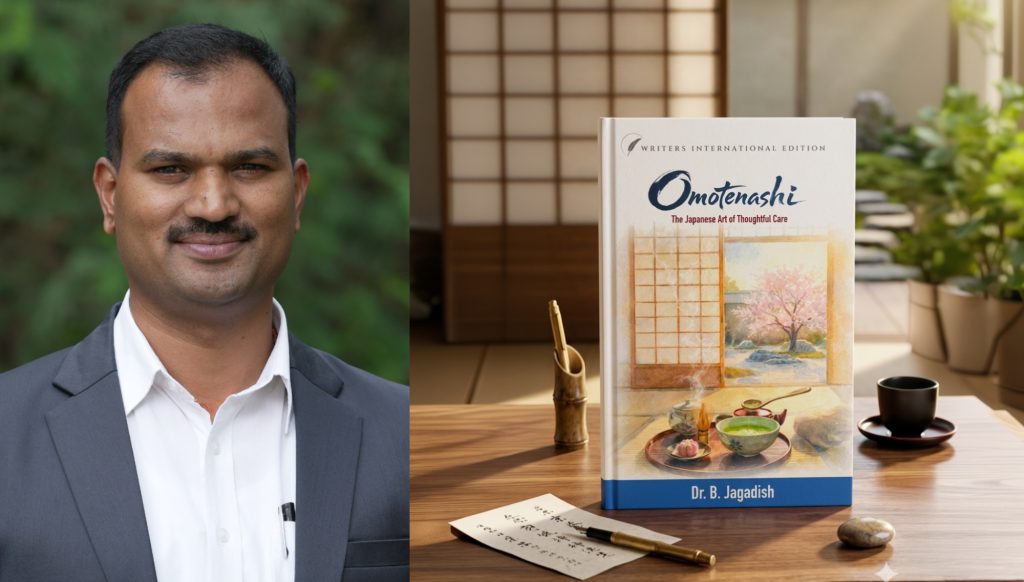
I never thought of this “thoughtful care” as a philosophy until I met Dr. Jagadish, an educator, author, and one of the most beautiful human beings I have encountered in my life, for a discussion on his new book. The conversation became the beginning of another publishing journey for our publishing house with Omotenashi: The Japanese Art of Thoughtful Care. As Dr. Jagadish spoke in detail about the idea behind the book, I realised that this was not merely a work on hospitality or Japanese culture. It was about something the modern world has slowly forgotten while becoming faster, louder, and more efficient. The ability to genuinely notice another human being.
Reading this book felt less like reading a theoretical work and more like walking through moments of quiet humanity. The beauty of the book lies in the fact that it does not romanticise kindness in abstract terms. Instead, it reveals Omotenashi through ordinary incidents that most people overlook. A mother preparing herbal drinks before dawn for her son, a neighbour rushing without hesitation to carry an unconscious elderly man downstairs, a government officer patiently helping a grieving widow complete pension formalities, a bus conductor offering the last vacant seat to a tired traveller, and healthcare workers navigating impossible situations during the pandemic with calm empathy. These are not extraordinary heroes in dramatic circumstances. They are ordinary people responding with sincerity to the needs of others. Dr. Jagadish gently demonstrates that Omotenashi begins precisely there. In the unnoticed corners of life.
What makes the work deeply meaningful is the way it connects this philosophy with both personal and professional life. Many books on leadership today speak about productivity, influence, strategy, or systems. Very few speak about human warmth with seriousness and intellectual clarity. Dr. Jagadish does exactly that. Drawing from his long association with Toyota and Lexus, he explains how anticipatory care and sincere attention become foundational not only in relationships but also in business excellence. The stories from Lexus dealerships, Japanese hospitality practices, airline services, hotels, and global organisations are not presented as management case studies alone. They become lessons in how institutions can remain human even within highly structured systems.
The chapters discussing the roots of Omotenashi in Zen philosophy, Bushidō, tea ceremonies, and Japanese cultural evolution are among the most insightful sections of the book. Yet Dr. Jagadish never allows the work to become academically distant. The language remains accessible, warm, and deeply reflective. One constantly feels that the author is not teaching from a pedestal but sharing something he himself has carefully lived and observed through years of experience.
One of the strongest aspects of the book is its relevance to contemporary life. We live in a time where interactions increasingly become transactional. People respond after being asked. Institutions care after complaints arise. Attention itself has become fragmented. In such a world, Omotenashi arrives almost like a quiet corrective. It reminds us that true care is proactive. It anticipates. It notices silence. It understands discomfort before words emerge. It restores dignity to everyday interaction.
There is another quality in the book that stayed with me long after reading it. The author never presents care as weakness or emotional excess. Instead, he presents it as discipline, awareness, refinement, and character. Omotenashi, in this sense, becomes not merely hospitality but a civilizational value. A way of living where relationships matter more than performance, where intention matters more than display, and where even the smallest gesture can carry immense emotional depth.
As someone associated with literature, publishing, and humanistic thought for many years, I rarely come across books that combine philosophy, lived experience, emotional sincerity, and practical relevance with such balance. Omotenashi: The Japanese Art of Thoughtful Care succeeds because it emerges from authenticity. Dr. Jagadish does not merely write about thoughtful care. One can feel that he has practiced it for decades in his interactions, leadership, and way of living.
What makes this journey even more meaningful for me is the fact that Dr. Jagadish’s Omotenashi is not merely a standalone book. It marks the beginning of the Life Series by Writers International Edition, a publishing initiative envisioned to bring meaningful, life-centred works to readers across the world. In many ways, I feel there could not have been a more appropriate beginning than a book that speaks about sincerity, empathy, mindfulness, and the forgotten beauty of caring for one another. What is even more heartening is that while Omotenashi continues its remarkable journey as one of our best-selling titles, Dr. Jagadish has already moved into his next work, which I believe is nearing completion. Having witnessed the depth of thought and humanity that shaped this book, I quietly feel the next one too will become a work that touches countless lives across the world.
Omotenashi: The Japanese Art of Thoughtful Care is not simply a book to be read and kept aside. It is a book that follows the reader into daily life. Into homes, workplaces, classrooms, hospitals, offices, friendships, and moments of silence. After reading it, one begins to observe life differently. One begins to notice the invisible labour of care surrounding us every day.
Perhaps that is the greatest success of this remarkable work. It does not ask us to become extraordinary people. It simply reminds us to become more human.
Buy ‘Omotenashi: The Japanese Art of Thoughtful Care’
Preeth Padmanabhan Nambiar
Summary
Omotenashi: The Japanese Art of Thoughtful Care by Dr. B. Jagadish is a deeply human exploration of the Japanese philosophy of anticipatory care, sincerity, and mindful attention. Through real-life experiences, cultural insights, and reflections drawn from both personal life and professional leadership, the book demonstrates how thoughtful care can transform relationships, workplaces, education, leadership, and society itself. More than a work on hospitality, the book presents Omotenashi as a way of living rooted in empathy, awareness, dignity, and genuine human connection. As the inaugural title of the Life Series by Writers International Edition, the book marks the beginning of an important literary initiative centred on values, mindfulness, and meaningful living.
Keywords
Omotenashi, Omotenashi book review, Dr. B. Jagadish, Japanese philosophy, thoughtful care, Japanese hospitality, mindful living, human values, empathy in leadership, Toyota philosophy, Lexus hospitality, anticipatory care, leadership and humanity, emotional intelligence, Japanese culture, Zen philosophy, Bushidō, tea ceremony, meaningful living, customer experience, leadership development, personal growth, mindfulness, compassionate leadership, Writers International Edition, Life Series, books on humanity, philosophy of care, modern leadership books, best books on relationships, books on empathy, hospitality philosophy, reflective book review