
Altered Connotation of Love in Netizens’ World: Sagas from Shalini Mullick’s ‘Stars from the Borderless Sea’
Since time immemorial, human culture is meant for frequent change and undoubtedly norms, impulses and ways of dealing keep changing and swinging like a pendulum generation after generation and the vicious cycle goes on. Though we think that there is no change in emotions, how people express themselves and use sentiments, is the same. But to note, when changes are taking place due to an upsurge in the usage of gizmos and gadgets, where life is more about being active on social media rather than taking care of real relations back at home and ground level, the kind of love ‘a deep-rooted emotion’ in humans, unfortunately, can be perceived, no more exist the same way on earth the way it used to be since folks instantaneously change and discard partners and loved ones like clothes and other materialistic stuff every third month or keep many parallel promoting polygamy. Where are Heer-Ranjha, Laila-Majnu and Romeo-Juliet kind of sagas lost in the world of social media?
 The same deep-rooted emotion of love, which seems missing in relationships, has found its abode in the sagas of Shalini Mullick’s Stars from the Borderless Sea. The article reconnoitres the intensity of emotions expressed through the characters, leading to productive discourse in the context of the altered connotations of love in the present era. The impermanence and feeling of insecurity the way people have in relations can be slackened if we feel the gravity and worth of relations beyond materialism. Understanding love and providing support beyond vested interests can assist in balancing and maintaining good relations for long.
Hence love is not just an emotion or sentiment for exchange or reciprocation or dealing like we do in business, it’s the core of one’s being flowing boisterously and required to handle delicately and with sensibility. Since it’s the source of immense energy and inner power, one needs to store and reserve it well being thoughtful and harmonizing one’s sentiments. Consequently, after reading Shalini Mullick’s stories, I felt it’s a perfect take to understand love beyond benefits and avarice or sexual wants.
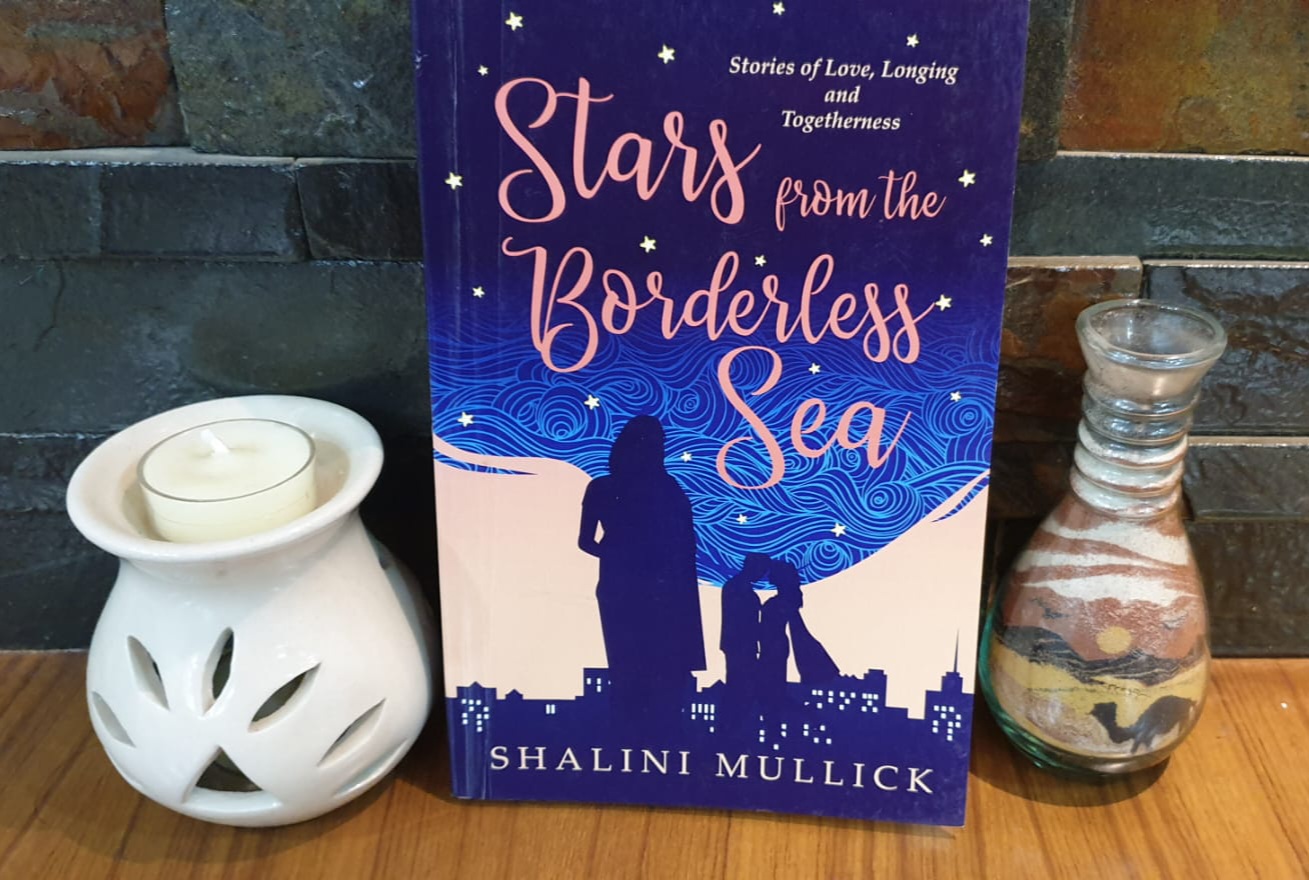
The sagas Humsafar, Sayonee and Humraaz reminded me of movies like Pakeezah in which Raj Kumar stares at sleeping Meena Kumari and leaves a note near her feet requesting not to place her feet on the ground as they would be dirty; and Veer-Zaara, a story of an Indian pilot and a Pakistani girl who beyond different ethnicity and religions, devote their lives to each other with commitment. In the era of netizens, where phone sex or real escorts are easily available everywhere who cares about commitment, honesty and integrity. Youth today has different connotations of love, as frequent friend-unfriend, follow-unfollow, like-dislike and block-unblock on social media are part and parcel of their lives and showcase the frivolity in their relationships.
Thus reading stories from the book of Shalini Mullick would surely give a different dimension to the prevailing concept of love recalling the times of retro or classics amalgamating them with present setting and her true-to-life characters. Although the protagonists go through the phase of separation or any financial crisis or bad marriage trauma and suffering, yet they stand together emotionally in all odds even without uttering a dialogue and with their silent inner and soulful support.
In A Midsummer Night’s Dream, Shakespeare says- “the course of true love never did run smooth.” Therefore, retaining love and reframing it in a positive form is a much-needed thing with other important values including tolerance, forgiveness, compassion, understanding, and acceptance which youth seems to lack somehow. Love needs to be taken as a power weapon shifting it from jealousy, hatred or an insulting tool to motivate, inspire, enthuse and improve.
What these stories epitomize, I would like to sum up that with a quote from 13th-century Persian poet and Sufi Mystic Rumi- “I love you neither with my heart, nor with my mind. My heart might stop and my mind can forget. I love you with my soul because my soul never stops or forgets.”
Channelling love in the right direction can make a person a better human being and leads toward success and the stories reveal the same kind of intense feeling. A must-read book in lucid language with a profundity of emotions to channelise your feelings and make your heart a golden heart!
Dr Shalini Yadav
Professor
Compucom Institute of Technology and Management
Jaipur, India
 Dr Shalini Yadav holds a PhD in Post-colonial Literature and M. Phil in English Language Teaching (ELT) from the University of Rajasthan, India. Additionally, she has done a course in Advanced Creative Writing from the University of Oxford, UK. She has progressive teaching experience of 16 years at the University level in India, Libya and Saudi Arabia. She has participated and presented papers in many conferences and seminars, chaired sessions and delivered lectures across the tenure. She has edited and authored various books including Reconnoitring Postcolonial Literature, Emerging Psyche of Women: A Feminist Perspective, On the Wings of Life: Women Writing Womanhood, Postcolonial Transition and Cultural Dialectics, Communication Techniques and A Text Book of English for Engineers. Besides, she is a freelance writer whose creative writing publications include three poetry books in English Floating Haiku, Kinship With You: A Collection of Poems, Till the End of Her Subsistence: An Anthology of Poems, and one in Hindi language entitled Kshitiz Ke Us Paar. She has recently edited an anthology of poetry titled Across the Seas. Many of her short stories and poems are published in numerous peer-reviewed journals and anthologies; besides, she is member of various virtual poetry and literary societies. She keeps reading her poems and short stories at various national and international poetry carnivals. She has meticulously written and also reviewed a big number of scholarly research articles for various National and International refereed journals and edited volumes. She is also an efficacious member of the editorial boards of various qualitative journals of various countries. She is editor of open page at Writers International Edition.


